What really happens when you multiply by 10
Multiplying by 10 makes every digit worth 10 times more: ones become tens, tens become hundreds… In a place value chart, all the digits slide one column to the left:
| hundreds | tens | ones | tenths | hundredths |
|---|---|---|---|---|
| 3. | 4 | 5 | ||
| 3 | 4. | 5 | ||
| 3 | 4 | 5 |
That's why we write a zero after a whole number: 45 × 10 is 4 hundreds and 5 tens, so 450. The zero holds the ones place, which has become empty.
Whole numbers: add zeros
| Calculation | Answer |
|---|---|
| 7 × 10 | 70 |
| 7 × 100 | 700 |
| 7 × 1,000 | 7,000 |
| 52 × 100 | 5,200 |
| 300 × 10 | 3,000 |
Decimals: the digits move left
The digits move as many places to the left as there are zeros (1 for × 10, 2 for × 100, 3 for × 1,000). You can also picture it as the decimal point moving to the right: it's the same result.
- 4.7 × 10 = 47
- 4.7 × 100 = 470 (a digit is missing, so fill the ones place with a zero)
- 0.25 × 10 = 2.5
- 0.25 × 1,000 = 250
- 12.036 × 100 = 1,203.6
And dividing by 10, 100 or 1,000?
It's exactly the opposite: every digit becomes 10 times smaller and moves to the right.
- 45 ÷ 10 = 4.5
- 45 ÷ 100 = 0.45
- 3 ÷ 1,000 = 0.003
Why it matters
It's used everywhere, at school and in everyday life:
- Converting measurements: 2.5 m = 250 cm (× 100), 3 kg = 3,000 g (× 1,000). See how to convert grams to kilograms.
- Mental maths: 25 × 40 is 25 × 4 × 10 = 100 × 10 = 1,000.
- Long multiplication: it's the idea behind the placeholder zero (see how to do long multiplication).
How to explain it to your child
- With money: ten £2 coins make £20; ten £50 notes make £500.
- With a place value chart: write the number, then write it again one column further left.
- Avoid "add a zero" for decimals and say "the digits move" instead.
- Always estimate before calculating.
The most common mistakes
- Adding a zero to a decimal: 3.45 × 10 = 3.450 (wrong: it's 34.5).
- Moving the digits the wrong way: 4.7 × 10 = 0.47.
- Forgetting to fill the gap with a zero: 4.7 × 100 = 47 (wrong: it's 470).
- Mixing up × 100 and × 1,000.
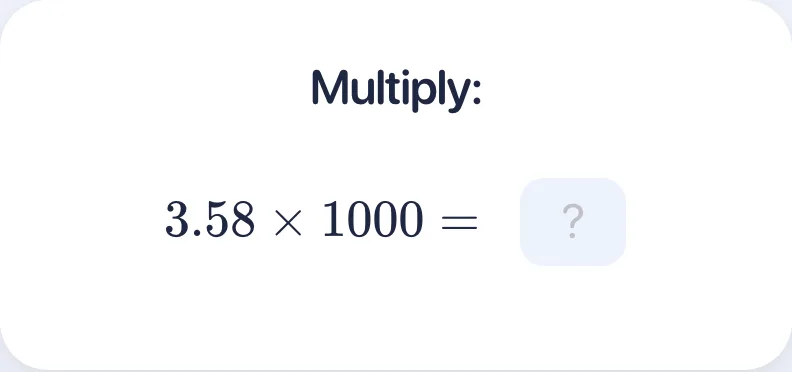
Worked examples
38 × 100
5.6 × 10
0.8 × 100
2.345 × 1,000
67 ÷ 100
Frequently asked questions
How do you multiply a decimal by 10?
Move every digit one place to the left (or the decimal point one place to the right): 3.45 × 10 = 34.5. Each digit becomes ten times bigger.
Why do you add a zero when multiplying by 10?
Because every digit moves one column to the left, leaving the ones column empty. The zero fills that place. This only works for whole numbers.
How do you divide by 10, 100 or 1,000?
Do the opposite: move the digits one, two or three places to the right, adding zeros if needed. 45 ÷ 100 = 0.45.
Keep reading: our lessons Calculating with decimals and Place value.
Find out where your child stands in 20 minutes
The EasyMaths assessment is free: around thirty varied questions covering the whole year’s curriculum, with clear results skill by skill and the exercises to work on next.
Take the free assessment →In the curriculum: Grade 3 (Year 3) · Grade 4 (Year 4) · Grade 5 (Year 5)
Keep reading
 Mental maths
Number bonds to 10: how to learn them
Number bonds to 10 (1 + 9, 2 + 8, 3 + 7…): why they matter, how to learn them with fingers and ten frames, what they're used for, and…
 Mental maths
Divisibility rules for 2, 3, 4, 5, 9 and 10
Divisibility rules for children: 2, 5 and 10 by the last digit, 3 and 9 by adding the digits, 4 by the last two digits. Why they work,…
 Mental maths
How to explain multiplication to a child
How to explain multiplication to a child: equal groups, repeated addition, arrays, why 4 × 6 = 6 × 4, real-life problems, then the times…