Step 1: equal groups
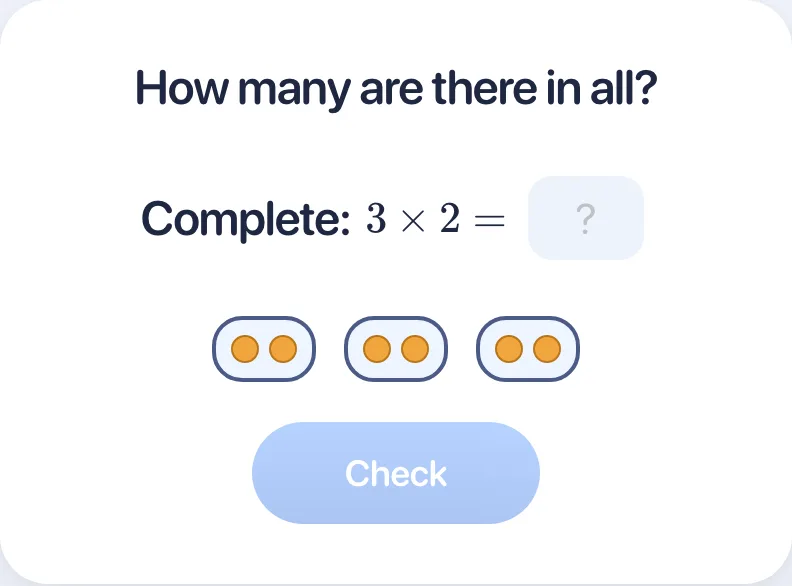
Everything starts with real objects. Make groups of the same size:
- 3 plates with 2 biscuits on each;
- 4 boxes of 5 pencils;
- 5 hands with 5 fingers each.
The key question: "How many groups? How many in each group?" For 4 boxes of 5 pencils: 4 groups, 5 in each, so 4 × 5: "4 groups of 5", or "4 lots of 5".
You can then count them all, and discover that adding is faster: 5 + 5 + 5 + 5 = 20. That's repeated addition, and multiplication is just a shorthand for it: 4 × 5 = 20.
Step 2: arrays (the best picture)
Put objects in rows and columns: that's an array. 4 rows of 6:
Arrays are everywhere: egg boxes (2 × 6), chocolate bars, windows, muffin trays. Get your child to spot them and say the multiplication.
Step 3: the order doesn't matter
Turn the array round: 4 rows of 6 become 6 rows of 4. The number of objects hasn't changed: 4 × 6 = 6 × 4 = 24.
This discovery is very important: it halves the number of facts to learn in the times tables. If you know 3 × 8, you also know 8 × 3.
Step 4: real-life situations
Multiplication becomes meaningful when it answers real questions:
- "There are 4 of us: if everyone has 3 pancakes, how many do I need to make?" (4 × 3 = 12)
- "A ticket costs £5: how much for 3 tickets?" (3 × 5 = £15)
- "A spider has 8 legs. How many legs do 2 spiders have?" (2 × 8 = 16)
Get your child to make up their own problems too: it's the best sign they've understood.
Step 5: only then, the times tables
Once the meaning is clear, it's time to learn the facts by heart, so they don't have to add every time. A child who understands multiplication learns their tables more easily, and can work out a forgotten fact (7 × 6 = 7 × 5 + 7 = 42). See our full guide: how to learn times tables.
How to explain it to your child (summary)
- Objects first, then drawings, then numbers.
- Always say "groups of" at first.
- Look for arrays in everyday life.
- Turn arrays round to show that the order doesn't matter.
- Little real-life problems every day.
The most common mistakes
- Confusing × and +: 3 × 4 = 7.
- Mixing up the number of groups and the size of the groups (not a problem for the answer, but important for understanding word problems).
- Learning tables by rote without understanding, and being stuck as soon as a fact is forgotten.
- Thinking multiplying always makes things bigger (× 1 and × 0 come as a surprise: 5 × 1 = 5, 5 × 0 = 0).
Worked examples
5 bags of 3 apples: write the multiplication
An egg box has 2 rows of 6. How many eggs?
Write 7 + 7 + 7 as a multiplication
If 6 × 4 = 24, what is 4 × 6?
Frequently asked questions
How do you explain simply what multiplication is?
It's adding the same number several times: 3 × 4 means 3 groups of 4, so 4 + 4 + 4 = 12. Show it with real objects in equal groups.
Should children learn times tables before understanding multiplication?
No. It's better to understand first (equal groups, arrays), then learn the facts. Understanding makes tables easier to learn and lets children work out a forgotten fact.
When do children start learning multiplication?
In England, children start with equal groups and counting in 2s, 5s and 10s in Year 1, use the × sign in Year 2, and learn all the times tables up to 12 × 12 by the end of Year 4.
Keep reading: how to learn times tables and our lesson Times tables.
Find out where your child stands in 20 minutes
The EasyMaths assessment is free: around thirty varied questions covering the whole year’s curriculum, with clear results skill by skill and the exercises to work on next.
Take the free assessment →In the curriculum: Grade 2 (Year 2) · Grade 3 (Year 3)
Keep reading
 Mental maths
How to find multiples of a number
What multiples are and how to find them: counting on, times tables, checking with division, multiples vs factors and the lowest common…
 Mental maths
How to halve a number in your head
How to halve a number in your head: halving and doubling, halving tens, splitting into tens and ones, and halving odd numbers. With…
 Mental maths
How to learn addition facts the easy way
How to help your child learn addition facts without endless chanting: doubles, number bonds to 10, bridging through 10, the best order…