What "multiple" means
A number is a multiple of another if it's in its times table. 12 is a multiple of 3, because 3 × 4 = 12. It's also a multiple of 1, 2, 4, 6 and 12.
Two ways to find multiples
- Count on: start from the number and keep adding it. Multiples of 6: 6, 12, 18, 24, 30…
- Use the times table: 6 × 1, 6 × 2, 6 × 3… It's the same list.
On a 100 square, colouring the multiples of a number reveals lovely patterns: the multiples of 5 make two columns, the multiples of 9 form diagonals, the multiples of 3 make slanting lines.
How to tell if a number is a multiple of another
Divide and look at the remainder:
- Is 42 a multiple of 7? 42 ÷ 7 = 6, no remainder: yes.
- Is 50 a multiple of 6? 50 ÷ 6 = 8 remainder 2: no.
For 2, 3, 5, 9 and 10 there are quick shortcuts: see divisibility rules.
Multiples or factors: don't mix them up
The two words are opposites, and children often swap them:
| Multiples of 12 | Factors of 12 | |
|---|---|---|
| What they are | numbers in the 12 times table | numbers that divide 12 exactly |
| List | 12, 24, 36, 48… (never ends) | 1, 2, 3, 4, 6, 12 (a short list) |
| Size | equal to or bigger than 12 | equal to or smaller than 12 |
A simple sentence links them: 3 is a factor of 12, so 12 is a multiple of 3.
Common multiples
A common multiple of two numbers is in both of their times tables.
- Multiples of 4: 4, 8, 12, 16, 20, 24…
- Multiples of 6: 6, 12, 18, 24, 30…
- Common multiples: 12, 24, 36…
The smallest one, 12, is the lowest common multiple (LCM). It's useful for adding fractions with different denominators (see how to compare fractions) and for problems like "one bus comes every 4 minutes, another every 6 minutes: when will they next arrive together?" (answer: in 12 minutes).
How to explain it to your child
- Colour multiples on a 100 square and look for patterns.
- Count in steps out loud: in 3s, 4s, 25s, while skipping or bouncing a ball.
- Use real-life puzzles: "Eggs come in boxes of 6: can you buy exactly 20 eggs?".
- Practise the multiple/factor difference with the same number in both columns.
The most common mistakes
- Confusing multiples and factors.
- Forgetting the number itself in its list of multiples.
- Thinking the list stops at 10 × the number.
- Saying 0 is not a multiple: at primary school it's usually left out, but mathematically 0 is a multiple of every number (n × 0 = 0).
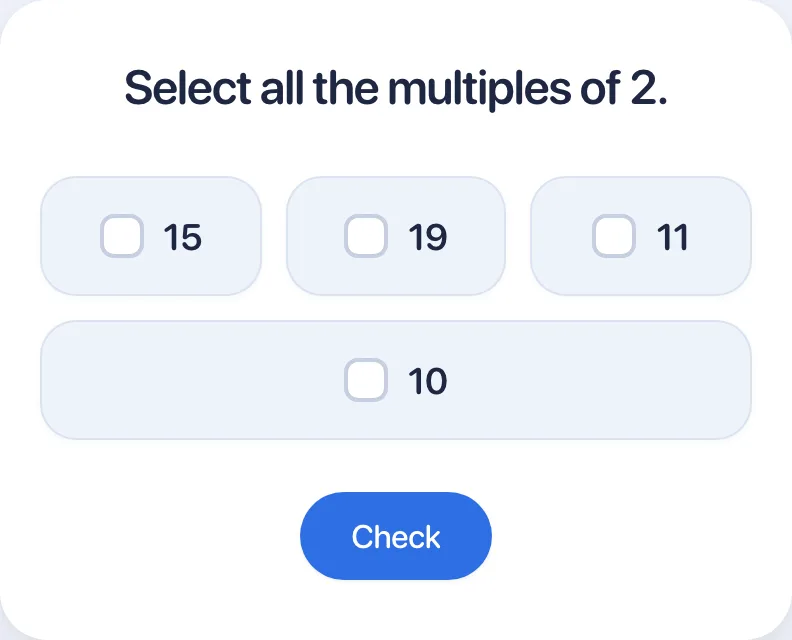
Worked examples
List the first five multiples of 7
Is 54 a multiple of 6?
Is 35 a multiple of 4?
Find the lowest common multiple of 3 and 5
Frequently asked questions
How do you know if a number is a multiple of another?
Divide it by the other number: if there's no remainder, it's a multiple. 42 ÷ 7 = 6, so 42 is a multiple of 7.
What's the difference between a multiple and a factor?
Multiples of a number are in its times table and go on forever (12, 24, 36…). Factors divide it exactly and form a short list (1, 2, 3, 4, 6, 12 for 12).
When do children learn about multiples?
In England, children count in multiples from Year 1, recognise multiples within the times tables in Year 3 and Year 4, and work with factors, multiples and common multiples in Year 5 and Year 6.
Keep reading: divisibility rules and our lesson Factors and multiples.
Find out where your child stands in 20 minutes
The EasyMaths assessment is free: around thirty varied questions covering the whole year’s curriculum, with clear results skill by skill and the exercises to work on next.
Take the free assessment →In the curriculum: Grade 4 (Year 4) · Grade 5 (Year 5) · Grade 6 (Year 6)
Keep reading
 Mental maths
How to halve a number in your head
How to halve a number in your head: halving and doubling, halving tens, splitting into tens and ones, and halving odd numbers. With…
 Mental maths
How to learn addition facts the easy way
How to help your child learn addition facts without endless chanting: doubles, number bonds to 10, bridging through 10, the best order…
 Mental maths
How to learn times tables (without the tears)
How to help your child learn their times tables: the best order, how long to practise, tricks for the 9 and 7 times tables, and the Year…