Halving and doubling: two inverse operations
Doubling a number means adding it to itself (double 8 = 16). Halving undoes that: half of 16 = 8. So the doubles your child already knows give them the halves for free:
| Double | Half |
|---|---|
| double 6 = 12 | half of 12 = 6 |
| double 7 = 14 | half of 14 = 7 |
| double 8 = 16 | half of 16 = 8 |
| double 9 = 18 | half of 18 = 9 |
Halving tens
With an even number of tens, it's just like halving ones: half of 80 is 40 (because half of 8 is 4).
With an odd number of tens, there's a ten left over, which splits into two fives: half of 70 = 30 + 5 = 35. The ones to know: half of 10 = 5, of 30 = 15, of 50 = 25, of 70 = 35, of 90 = 45.
Two-digit numbers: split them up
Example: half of 46
- half of 40 = 20
- half of 6 = 3
- total: 23
Example: half of 34
- half of 30 = 15
- half of 4 = 2
- total: 17
Example: half of 78
- half of 70 = 35
- half of 8 = 4
- total: 39
Another way that works well for some numbers: half of 38 is close to half of 40 (20), minus half of 2 (1) = 19.
And half of an odd number?
An odd number can't be split into two equal whole numbers. Half of 7 is 3 and a half, written 3.5 (or 3½). Half of 25 = 12.5. Children usually meet this in Year 3 or Year 4, often with money: half of £5 is £2.50.
Where halving is used
- Fractions: halving is finding 1/2 of an amount (see fractions of amounts).
- Times tables: the 5 times table is half the 10 times table (5 × 8 = half of 80 = 40).
- Quarters: halve, then halve again (a quarter of 36 = half of 18 = 9).
- Everyday life: sharing sweets, halving a recipe.
How to explain it to your child
- Share real objects fairly between two people.
- Use coins: halve 30p using a 20p and a 10p (swap the 10p for two 5p coins).
- Practise doubles first, since halving relies on them.
- Talk through the splitting out loud: "half of 50 is 25, half of 6 is 3, so 28".
The most common mistakes
- Halving the digits separately: half of 34 = 1 and 2 → "12" (wrong: it's 17).
- Forgetting the leftover ten in an odd number of tens: half of 50 = 20 (wrong).
- Thinking odd numbers can't be halved.
- Mixing up halving and doubling.
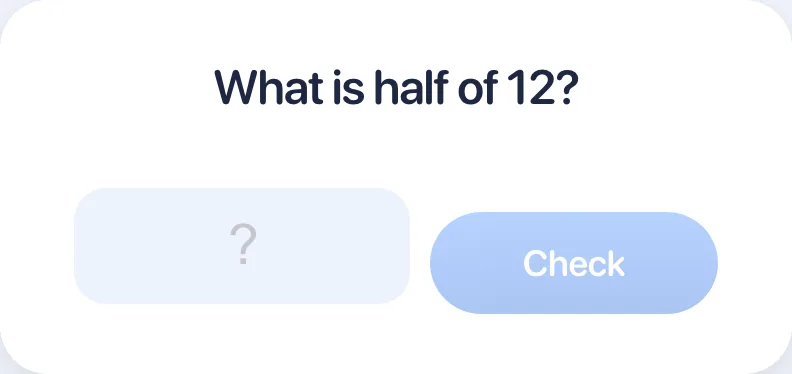
Worked examples
Half of 60
Half of 90
Half of 52
Half of 96
Half of 15
Frequently asked questions
How do you halve a big number?
Split it into parts that are easy to halve (hundreds, tens, ones), halve each part and add them. Half of 346 = 150 + 20 + 3 = 173.
What is half of an odd number?
It isn't a whole number: it ends in a half. Half of 7 is 3.5, half of 25 is 12.5.
When do children learn halving and doubling?
In England, children find halves of shapes and quantities in Year 1 and Year 2, recall doubles and halves of numbers to 20 in Year 2, and halve larger numbers mentally in Year 3 and Year 4.
Keep reading: how to learn addition facts and our lesson Division facts.
Find out where your child stands in 20 minutes
The EasyMaths assessment is free: around thirty varied questions covering the whole year’s curriculum, with clear results skill by skill and the exercises to work on next.
Take the free assessment →In the curriculum: Grade 1 (Year 1) · Grade 2 (Year 2) · Grade 3 (Year 3)
Keep reading
 Mental maths
How to learn addition facts the easy way
How to help your child learn addition facts without endless chanting: doubles, number bonds to 10, bridging through 10, the best order…
 Mental maths
How to learn times tables (without the tears)
How to help your child learn their times tables: the best order, how long to practise, tricks for the 9 and 7 times tables, and the Year…
 Mental maths
Multiplying by 10, 100 and 1,000
How to multiply whole numbers and decimals by 10, 100 and 1,000: why the digits move, why 'add a zero' fails for decimals, and dividing.…