Why they matter so much
Addition facts (from 1 + 1 to 10 + 10) underpin all calculation: subtraction, column addition, mental maths, multiplication… A child who has to count on their fingers to find 7 + 6 will tire on everything else. The goal by the end of Year 2: answering within about 3 seconds, without counting.
Good news: there's much less to learn than it seems
- The order doesn't matter: 3 + 8 = 8 + 3. That almost halves the number of facts.
- + 0 and + 1 are instant: 7 + 0 = 7, 7 + 1 = 8 (the next number).
- + 2 is "the next number, then the next".
In the end there are only about twenty truly "new" facts, and nearly all of them can be worked out using two big strategies: doubles and bridging through 10.
Strategy 1: doubles (and near doubles)
Doubles are easy to remember because they're visual: 2 + 2 (two hands with two fingers), 5 + 5 (two hands), 6 + 6 (an egg box)…
| Double | Answer |
|---|---|
| 1 + 1 | 2 |
| 2 + 2 | 4 |
| 3 + 3 | 6 |
| 4 + 4 | 8 |
| 5 + 5 | 10 |
| 6 + 6 | 12 |
| 7 + 7 | 14 |
| 8 + 8 | 16 |
| 9 + 9 | 18 |
Once the doubles are known, the near doubles follow:
- 6 + 7 is 6 + 6 + 1 = 13;
- 8 + 7 is 7 + 7 + 1 = 15, or 8 + 8 − 1 = 15.
Strategy 2: number bonds to 10
Knowing what to add to make 10 is fundamental: 7 + 3, 6 + 4, 8 + 2… A ten frame makes it obvious:
See our full article: number bonds to 10.
Strategy 3: bridging through 10
This is THE technique for every sum that goes past 10. For 8 + 5:
- You need 2 to get from 8 to 10.
- Split 5 into 2 + 3.
- 8 + 2 = 10, then 10 + 3 = 13.
With a little practice, children do this split in their heads in a second. And the same technique will help later with 38 + 5, 98 + 7…
Suggested order
- + 0, + 1, + 2 (Reception, Year 1)
- Doubles up to 5 + 5, then up to 10 + 10
- Number bonds to 10
- Near doubles (6 + 7, 4 + 5…)
- Bridging through 10 (8 + 5, 7 + 6…)
- + 9 with the + 10 − 1 trick
One step every week or two, always revising the previous ones.
Games to practise without getting bored
- Addition snap/war: each player turns over two cards (1 to 9) and says the total; the higher total wins.
- Dice game: roll two dice; the first to say the total scores a point.
- Doubles in the car: "What's 6 + 6? And 6 + 7?".
- A ten frame drawn on paper with counters or pasta.
- Online practice, with one exercise per fact family ("Add 7", "Add 8"…) and instant feedback.
Pitfalls to avoid
- Letting finger-counting go on too long: it's normal at first, but children then need to move on to strategies.
- Always reciting in order: your child needs to answer in any order.
- Sessions that are too long: 5 to 10 minutes a day is enough.
- Moving on too quickly: a fact is known when the answer is instant, several days in a row.
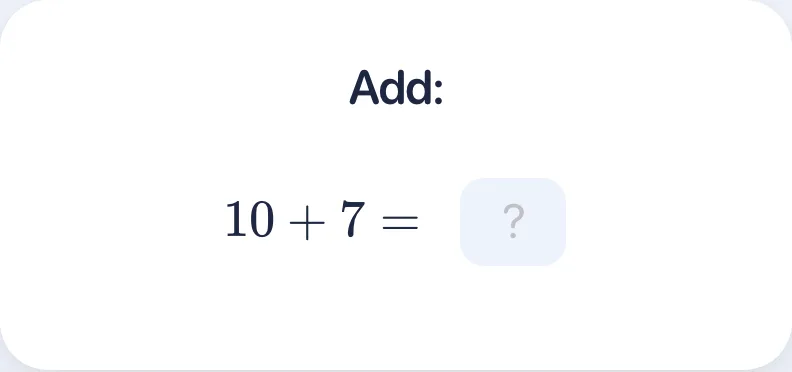
Worked examples
6 + 7 (near double)
9 + 4 (bridging through 10)
7 + 5 (bridging through 10)
8 + 8 (double)
5 + 8
Frequently asked questions
How long does it take to learn addition facts?
They're built up over Reception, Year 1 and Year 2. With a few minutes of practice a day and good strategies (doubles, bridging through 10), most children know them well by the end of Year 2.
Do addition facts have to be learned by heart?
Some facts need to be automatic (doubles, number bonds to 10). The rest can be worked out very quickly from those key facts. The final goal is to answer without counting.
My child still counts on their fingers in Year 2: is that a problem?
Not in itself, but it's a sign to work on strategies: doubles, number bonds to 10 and bridging through 10. These are what will free them from finger-counting.
Keep reading: our lesson Column addition and tens and ones.
Find out where your child stands in 20 minutes
The EasyMaths assessment is free: around thirty varied questions covering the whole year’s curriculum, with clear results skill by skill and the exercises to work on next.
Take the free assessment →In the curriculum: Grade 1 (Year 1) · Grade 2 (Year 2)
Keep reading
 Mental maths
How to learn times tables (without the tears)
How to help your child learn their times tables: the best order, how long to practise, tricks for the 9 and 7 times tables, and the Year…
 Mental maths
Multiplying by 10, 100 and 1,000
How to multiply whole numbers and decimals by 10, 100 and 1,000: why the digits move, why 'add a zero' fails for decimals, and dividing.…
 Mental maths
Number bonds to 10: how to learn them
Number bonds to 10 (1 + 9, 2 + 8, 3 + 7…): why they matter, how to learn them with fingers and ten frames, what they're used for, and…