Why it's the most important idea in Year 1
Understanding that the 3 in 34 is worth 30 (not 3) is the key to everything that follows: column addition and subtraction, exchanging, big numbers, decimals… Many difficulties in Year 4 or Year 5 go back to place value that wasn't fully understood in Year 1.
Step 1: make groups of 10
Give your child a handful of objects (pasta, straws, Lego) and ask them to count them. They'll count one by one, and often go wrong. Then suggest making groups of 10 (with elastic bands or little bags).
With 34 pasta shells, they get 3 groups of 10 and 4 shells on their own. Now they can count much faster: "10, 20, 30… 31, 32, 33, 34".
That's exactly what teachers do with base ten equipment (often called Dienes): rods of 10 cubes stuck together and single cubes.
Step 2: write the number in a place value chart
| tens | ones |
|---|---|
| 3 | 4 |
| 4 | 0 |
| 4 |
The chart shows that the place of a digit changes its value: in 40, the 4 is worth 4 tens (40); in 4, it's worth 4 ones.
The role of zero
Zero shows that there's nothing in a column. In 40, there are no ones on their own: it's exactly 4 groups of ten. Without the zero, you'd read "4". That's why it can't be left out!
Swapping 10 ones for 1 ten
This idea prepares children for exchanging. When you have 12 ones, you can make 1 group of 10, with 2 left over: 12 ones = 1 ten and 2 ones. The other way round, you can "break" a ten into 10 ones (that's the exchanging in subtraction: see column subtraction with exchanging).
The tricky teen numbers
In English, the names of the numbers from 11 to 19 don't match tens and ones in a helpful way, which can confuse children:
- eleven and twelve don't sound like "ten-one" and "ten-two";
- in thirteen to nineteen, you hear the ones first ("four-teen" for 14) even though the tens digit is written first. Children sometimes write 41 for "fourteen" for this reason.
Take time to match the name and the written number with base ten equipment or a place value chart: 14 is 1 ten and 4 ones.
How to explain it to your child
- Use lots of hands-on materials before any written work: bundles of 10 straws, egg boxes of 10…
- Get them to say numbers in two ways: "34 is 3 tens and 4 ones" and "34 is 30 and 4".
- Count in tens while showing the groups: 10, 20, 30, 40…
- Ask "tricky" questions: "How many tens are in 51?"; "How many groups of 10 are in 80?".
The most common mistakes
- Confusing the digit and its value: saying the 3 in 34 is worth 3.
- Reversing the digits: writing 43 for "thirty-four", or 41 for "fourteen".
- Forgetting the zero: writing 4 for "forty".
- Writing 304 for "thirty-four": writing 30 and then 4 side by side instead of 3 tens and 4 ones.
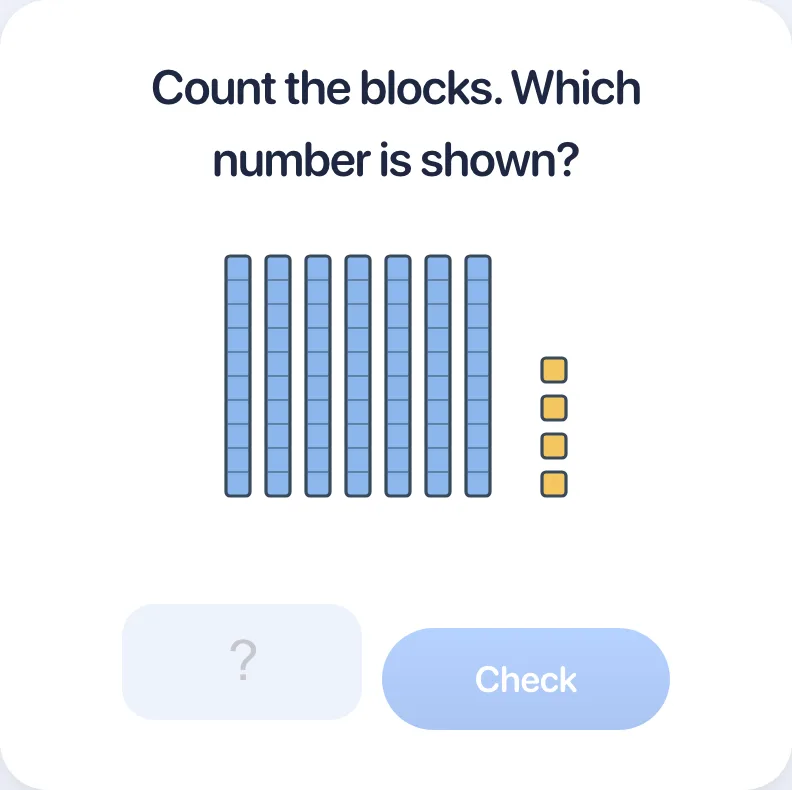
Worked examples
How many tens and ones are in 58?
Which number has 6 tens and 0 ones?
Which number has 2 tens and 14 ones?
Write "seventy-five" in digits
Frequently asked questions
How do you explain what a ten is?
A ten is a group of 10. Let your child handle objects: with 34 things, they make 3 groups of 10 with 4 left over. So they have 3 tens and 4 ones.
When do children learn tens and ones?
In England, children work with tens and ones in Year 1 (numbers to 100) and Year 2. Hundreds come in Year 3, thousands in Year 4.
Why does my child reverse digits (41 instead of 14)?
It's common, partly because we say "four-teen" with the ones first. Go back to base ten equipment and a tens and ones chart: the tens digit is always written on the left.
Keep reading: our lesson Place value and partitioning numbers.
Find out where your child stands in 20 minutes
The EasyMaths assessment is free: around thirty varied questions covering the whole year’s curriculum, with clear results skill by skill and the exercises to work on next.
Take the free assessment →In the curriculum: Grade 1 (Year 1) · Grade 2 (Year 2)
Keep reading
 Place value
How to read large numbers
How to read and write large numbers: split them into groups of three with commas, read each group with its name (million, thousand),…
 Place value
How to teach a child to count
How to teach a young child to count: why reciting isn't counting, one-to-one counting, small amounts at a glance, going past 10, games…
 Place value
How to write numbers in words
How to write numbers in words in British English: tricky spellings, hyphens from 21 to 99, where 'and' goes, hundred with no s, and…