Reciting is not counting
Many young children can chant "one, two, three… ten" very early, like a nursery rhyme. That's a great start, but it isn't counting yet. To really count a set of objects, a child needs to master several things at once:
- The number words in order, always the same.
- One number word per object: no more, no less (one-to-one correspondence).
- Not forgetting any object and not counting any twice.
- The last number said is the total (cardinality): "one, two, three, four: there are four".
- The order doesn't matter: counted left to right or right to left, there are still four.
Point 4 is often the last to arrive. Test it: after counting four teddies, ask "So how many teddies are there?". If your child counts again from the start, they haven't quite understood it yet: that's normal before 4 or 5.
Tips for counting well
- Touch or move each object while saying the number: moving counted objects to one side avoids counting them twice.
- Line the objects up at first: it's much easier than counting a jumbled pile.
- Count slowly, together, pointing with a finger.
- Always finish with the question "So how many are there?".
Recognising small amounts at a glance
Adults don't count 3 dots on a dice: they see 3 straight away. This skill (called subitising) can be learned, and it really helps young children:
- Dice and dominoes: the dot patterns become familiar very quickly.
- Fingers: showing 3 or 5 fingers without counting.
- Ten frames: 2 rows of 5, which help children see 7 as "5 and 2".
Going past 10
Beyond 10, the number words become irregular in English (eleven, twelve, and thirteen to nineteen, where you hear the ones first). Children often stumble here, and later on when moving to a new ten ("…twenty-eight, twenty-nine, … twenty-ten?").
- Count in tens with bundles: 10 straws in an elastic band make a ten. 23 is two bundles and 3 straws (see tens and ones).
- Practise "crossing the tens": 19, 20; 29, 30; 39, 40.
- Count on from any number, not always from 1: "start at 6 and count to 12".
- Count backwards too: rocket countdowns are perfect for this.
Games for learning to count
- Counting everyday things: stairs, buttons, cars of a certain colour, grapes on a plate.
- Board games with dice (snakes and ladders): reading the dice and moving the right number of squares.
- Laying the table: "We need one fork for each person: how many forks?".
- Hide and seek: counting to 10 or 20 out loud.
- Number songs and rhymes: "Five little ducks", "Ten green bottles" (counting back).
Signs that all is well (and when to talk to someone)
Every child develops at their own pace. As a rough guide, many children:
- recite up to 10 around age 3 to 4;
- count a small set of objects correctly (up to 5, then 10) around age 4 to 5;
- count to 20 and beyond in Reception (age 4 to 5) and Year 1.
If your child, well into Year 1, still can't count a small set of objects correctly or recognise small amounts, mention it to the teacher. It may be nothing, but it's worth keeping an eye on.
The most common mistakes
- Counting the same object twice or skipping one.
- Saying the number words faster than they point (or the other way round).
- Not knowing the answer at the end and counting again from the start.
- Getting stuck when crossing a ten (twenty-nine, twenty-ten).
Worked examples
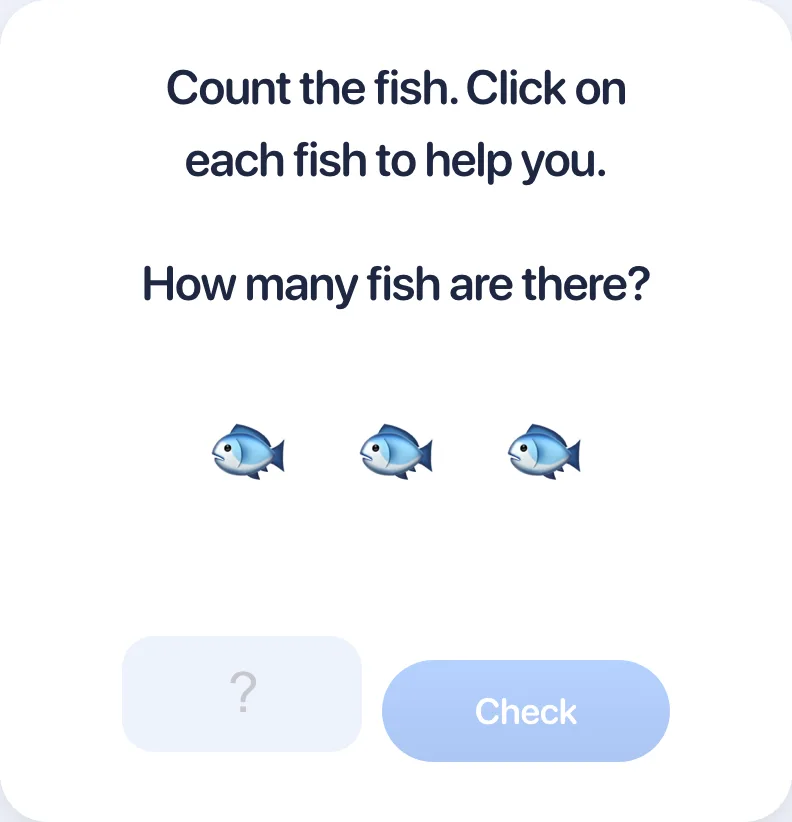
Your child counts 5 cars but touches one twice. What should you do?
After counting 6 blocks, your child doesn't know "how many". Is that a problem?
Your child says "twenty-nine, twenty-ten". How can you help?
Frequently asked questions
At what age can a child count to 10?
Many children can recite to 10 around age 3 to 4, and count a set of 10 objects correctly around age 4 to 5. Every child has their own pace.
My child can say the numbers but can't count objects: is that normal?
Yes, it's a very common stage. Reciting comes first; matching each number to one object and understanding the total come later, with lots of practice using real objects.
Should I let my child count on their fingers?
Yes. Fingers are a natural and useful tool for counting and understanding small numbers. They gradually stop being needed as children learn number facts.
Keep reading: number bonds to 10 and our lesson Place value.
Find out where your child stands in 20 minutes
The EasyMaths assessment is free: around thirty varied questions covering the whole year’s curriculum, with clear results skill by skill and the exercises to work on next.
Take the free assessment →In the curriculum: Kindergarten (Reception) · Grade 1 (Year 1)
Keep reading
 Place value
How to write numbers in words
How to write numbers in words in British English: tricky spellings, hyphens from 21 to 99, where 'and' goes, hundred with no s, and…
 Place value
How to tell if a number is odd or even
How to tell if a number is odd or even: just look at the last digit. Why it works, how to explain it with pairs, and the odd and even…
 Place value
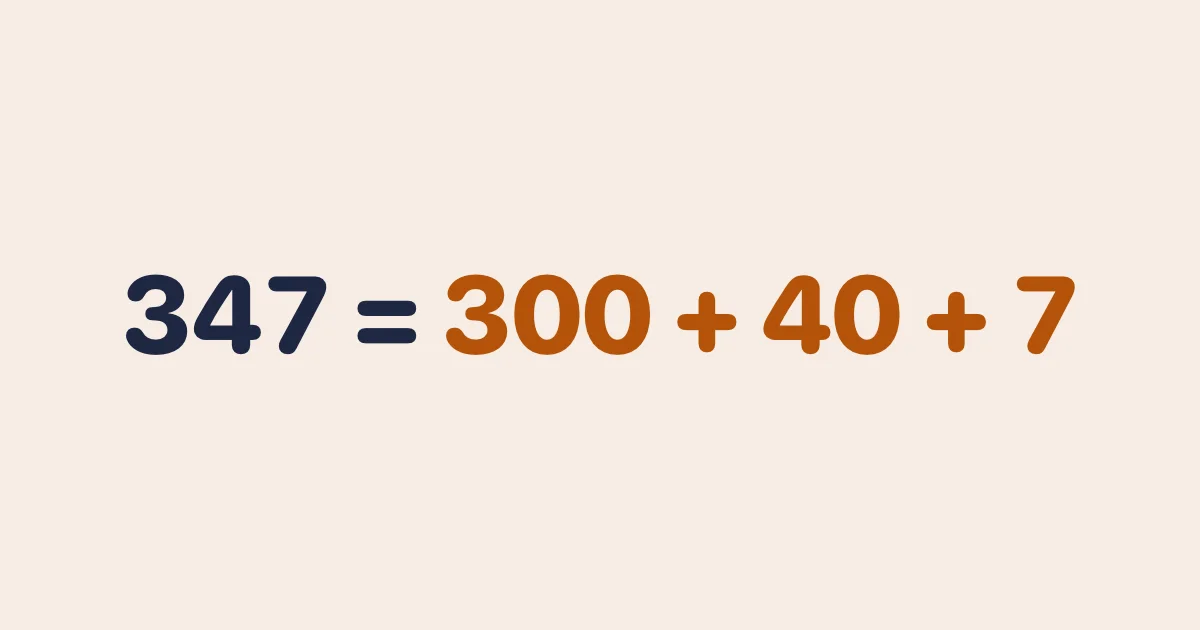
Partitioning numbers into hundreds, tens and ones
How to partition numbers into hundreds, tens and ones: 347 = 300 + 40 + 7. Different ways to partition, the place value chart, zeros and…