Why they matter so much
Our number system works in groups of 10. Knowing how to "make 10" helps children to:
- add quickly past 10: 8 + 5 = 8 + 2 + 3 = 13;
- subtract: 13 − 5 = 13 − 3 − 2 = 8;
- do mental maths with bigger numbers: 47 + 3 = 50, then number bonds to 100 (65 + 35 = 100);
- work out change when shopping.
It's one of the most useful things a child learns in the early years.
The five pairs to know
| Pair | And the other way round |
|---|---|
| 1 + 9 = 10 | 9 + 1 = 10 |
| 2 + 8 = 10 | 8 + 2 = 10 |
| 3 + 7 = 10 | 7 + 3 = 10 |
| 4 + 6 = 10 | 6 + 4 = 10 |
| 5 + 5 = 10 |
Not forgetting 0 + 10 = 10.
Fingers: the perfect tool
Two hands make 10 fingers! Hold up 3 fingers: how many are down? 7. Your child sees straight away that 3 + 7 = 10. It's the best way to start, from Reception.
With a ten frame
The ten frame (two rows of 5 boxes) is a favourite in classrooms. Put in some counters and count the empty spaces:
The two rows of 5 help a lot: 7 is "a full row and 2 more", so 3 are missing.
How to help them learn
- Hands-on: fingers, counters, ten frames, coins.
- Talk it through: "6, to make 10 I need… 4".
- Practise out loud, in any order, a few minutes a day.
- Play games (see below).
Three games that work
- The hands game: hold up some fingers; your child says how many more make 10.
- Pairs to 10: spread out cards from 1 to 9 face up; pick up pairs that make 10.
- "How many to 10?" in the car or at bath time: "4?": "6!".
After number bonds to 10: number bonds to 100
In Year 2, children move on to making the next ten (37 + 3 = 40), then number bonds to 100:
- for multiples of ten: 30 + 70 = 100, 60 + 40 = 100 (it's just like bonds to 10!);
- for other numbers: 65 + ? = 100 → go to the next ten (65 + 5 = 70), then to 100 (70 + 30 = 100): the bond is 35.
The most common mistakes
- Counting one by one instead of "seeing" the pair (normal at first, but to grow out of).
- Mixing them up with doubles: 5 + 5 = 10, but 4 + 4 = 8, not 10.
- Bonds to 100: making the tens add to 10 (65 + 45 = 110: wrong).
Worked examples
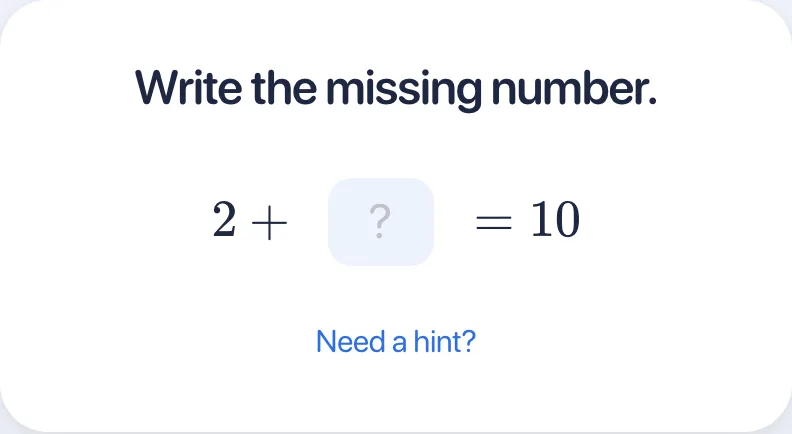
7 + ? = 10
? + 4 = 10
8 + 5, bridging through 10
43 + ? = 50
72 + ? = 100
Frequently asked questions
What are the number bonds to 10?
They're the pairs of numbers that add up to 10: 1 and 9, 2 and 8, 3 and 7, 4 and 6, 5 and 5 (and 0 and 10).
When do children learn number bonds?
In England, children explore number bonds to 5 and 10 in Reception, learn them by heart in Year 1, and move on to number bonds to 100 in Year 2.
How do you work out a number bond to 100?
Go to the next ten first, then to 100. For 65: 65 + 5 = 70, then 70 + 30 = 100. The number bond is 5 + 30 = 35.
Keep reading: how to learn addition facts and our lesson Column addition.
Find out where your child stands in 20 minutes
The EasyMaths assessment is free: around thirty varied questions covering the whole year’s curriculum, with clear results skill by skill and the exercises to work on next.
Take the free assessment →In the curriculum: Kindergarten (Reception) · Grade 1 (Year 1) · Grade 2 (Year 2)
Keep reading
 Mental maths
Divisibility rules for 2, 3, 4, 5, 9 and 10
Divisibility rules for children: 2, 5 and 10 by the last digit, 3 and 9 by adding the digits, 4 by the last two digits. Why they work,…
 Mental maths
How to explain multiplication to a child
How to explain multiplication to a child: equal groups, repeated addition, arrays, why 4 × 6 = 6 × 4, real-life problems, then the times…
 Mental maths
How to find multiples of a number
What multiples are and how to find them: counting on, times tables, checking with division, multiples vs factors and the lowest common…