The table to know
| Divisible by… | Rule | Example |
|---|---|---|
| 2 | the last digit is even (0, 2, 4, 6, 8) | 348 ✔ |
| 5 | the last digit is 0 or 5 | 1,275 ✔ |
| 10 | the last digit is 0 | 2,460 ✔ |
| 3 | the sum of the digits is a multiple of 3 | 531 → 5 + 3 + 1 = 9 ✔ |
| 9 | the sum of the digits is a multiple of 9 | 531 → 9 ✔ |
| 4 | the last two digits make a multiple of 4 | 1,316 → 16 ✔ |
| 6 | divisible by 2 and by 3 | 534 → even, 5 + 3 + 4 = 12 ✔ |
By 2, 5 and 10: the last digit is enough
Why only the last digit? Because every number of tens (10, 20, 30…) is divisible by 2, 5 and 10. So the tens, hundreds and thousands never get in the way: only the ones decide. It's the same reasoning as for odd and even numbers.
By 3 and 9: add up the digits
Add up all the digits of the number:
- 531 → 5 + 3 + 1 = 9: in the 3 times table and in the 9 times table → divisible by 3 and by 9.
- 714 → 7 + 1 + 4 = 12: in the 3 times table but not the 9 → divisible by 3, not by 9.
- 832 → 8 + 3 + 2 = 13: not in the 3 times table → not divisible by 3.
Why does it work? Because 10, 100, 1,000… are each 1 more than a multiple of 9 (9, 99, 999…). Curious children love this explanation, but they don't need it to use the rule.
By 4: the last two digits
Every multiple of 100 is divisible by 4 (100 = 4 × 25). So only the last two digits matter:
- 1,316 → 16 = 4 × 4 → divisible by 4 ✔
- 2,522 → 22 isn't in the 4 times table → not divisible ✗
A trick for the last two digits: halve them twice. If you still get a whole number, it's divisible by 4 (16 → 8 → 4 ✔; 22 → 11 → 5.5 ✗).
What are they for?
- Simplifying fractions: 45/60: both end in 0 or 5, so divide by 5 (see how to simplify fractions).
- Finding factors of a number quickly.
- Checking a division or a times table answer.
- Sharing problems: can 126 pupils be put into teams of 3 with nobody left out? 1 + 2 + 6 = 9, so yes.
How to explain it to your child
- Start with 2, 5 and 10, which use the times tables your child already knows.
- Turn 3 and 9 into a game: give a big number, they add up the digits, you check with a calculator.
- Show them the rules work on lots of examples before explaining why.
- Make a little reference card to keep in their pencil case.
The most common mistakes
- Using the "add the digits" rule for 2 or 5: it only works for 3 and 9.
- Looking at the first digit instead of the last.
- For 4, looking only at the last digit (14 ends in 4 but isn't divisible by 4).
- Thinking divisible by 3 means divisible by 9 (it's the other way round).
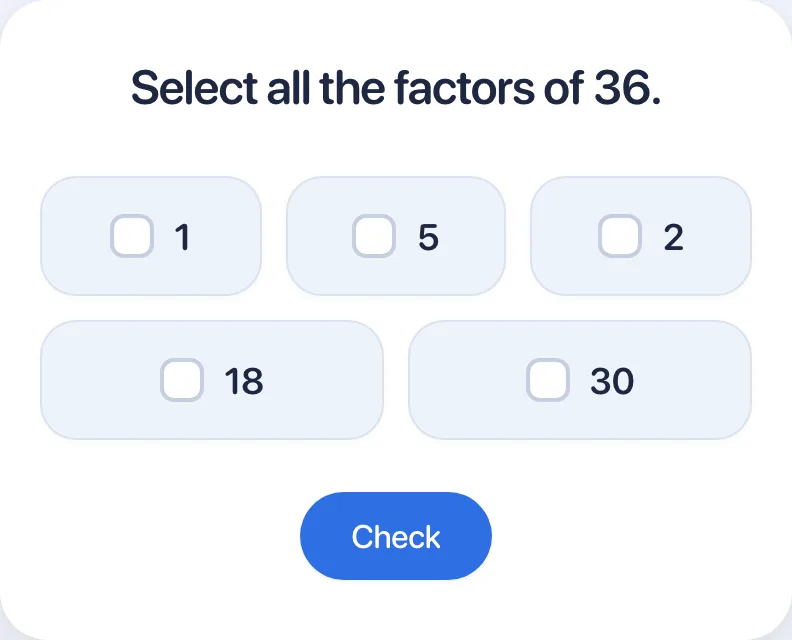
Worked examples
Is 2,345 divisible by 5?
Is 4,512 divisible by 3?
Is 4,512 divisible by 9?
Is 738 divisible by 4?
Is 612 divisible by 6?
Frequently asked questions
What is the divisibility rule for 3?
Add up the digits of the number: if the total is in the 3 times table, the number is divisible by 3. For 531: 5 + 3 + 1 = 9, so it is.
How do you know if a number is divisible by 4?
Look at the number made by its last two digits: if that is divisible by 4, so is the whole number. 1,316 ends in 16, which is 4 × 4.
When do children learn divisibility rules?
In England, children use divisibility when working with factors, multiples and prime numbers in Year 5 and Year 6.
Keep reading: how to find multiples of a number and our lesson Factors and multiples.
Find out where your child stands in 20 minutes
The EasyMaths assessment is free: around thirty varied questions covering the whole year’s curriculum, with clear results skill by skill and the exercises to work on next.
Take the free assessment →In the curriculum: Grade 4 (Year 4) · Grade 5 (Year 5) · Grade 6 (Year 6)
Keep reading
 Mental maths
How to explain multiplication to a child
How to explain multiplication to a child: equal groups, repeated addition, arrays, why 4 × 6 = 6 × 4, real-life problems, then the times…
 Mental maths
How to find multiples of a number
What multiples are and how to find them: counting on, times tables, checking with division, multiples vs factors and the lowest common…
 Mental maths
How to halve a number in your head
How to halve a number in your head: halving and doubling, halving tens, splitting into tens and ones, and halving odd numbers. With…