Why simplifying doesn't change the value
This is the key idea children need before any technique. Break a chocolate bar into 8 squares and eat 6 of them: you've eaten 68 of the bar. If the same bar had been broken into 4 big pieces, you would have eaten 3 of them: 34. It's the same amount of chocolate.
Simplifying is really grouping the pieces together: fewer, bigger pieces instead of lots of small ones. Nothing is lost: it's just written more simply.
The method, step by step
- Find a number that divides into both the numerator and the denominator. Try 2, then 3, then 5, then 7.
- Divide the top and the bottom by that number.
- Repeat with the new fraction.
- Stop when no number (apart from 1) divides into both: the fraction is in its simplest form.
Example: simplify 12/18
- 12 and 18 are both even, so divide by 2 → 1218 = 69.
- 6 and 9 are both in the 3 times table, so divide by 3 → 69 = 23.
- 2 and 3 share no other factor: 1218 = 23. Done.
You could get there in one step by dividing by 6 (because 12 = 6 × 2 and 18 = 6 × 3). Both routes give the same answer: what matters is reaching the simplest form.
Quick ways to spot the right number
To check quickly whether you can divide by 2, 3, 5 or 10, use these divisibility rules:
| You can divide by… | if the number… | Examples |
|---|---|---|
| 2 | ends in 0, 2, 4, 6 or 8 (it's even) | 14, 36, 120 |
| 3 | has digits that add up to a multiple of 3 | 51 (5 + 1 = 6), 123 (1 + 2 + 3 = 6) |
| 5 | ends in 0 or 5 | 25, 40, 135 |
| 10 | ends in 0 | 30, 250 |
| 9 | has digits that add up to a multiple of 9 | 81 (8 + 1 = 9), 234 (2 + 3 + 4 = 9) |
How do you know when a fraction is fully simplified?
A fraction is in its simplest form when the only number that divides into both the numerator and the denominator is 1. For example:
- 79 is fully simplified: 7 is only in the 1 and 7 times tables, and 9 isn't in the 7 times table.
- 1516 is fully simplified: 15 is odd (so not divisible by 2), and 16 isn't divisible by 3 or 5.
- 2135 isn't: 21 = 3 × 7 and 35 = 5 × 7, so you can divide by 7 → 35.
In secondary school, children learn to find the highest common factor (HCF) to simplify in a single step. In primary school, the "little by little" method works perfectly well.
How to explain it to your child
- Start with something real: a pizza cut into 8 slices where you eat 4 is half the pizza. Get them to say "48 is the same as 12".
- Check with a drawing: two strips of the same length, one split into 8, the other into 4. They shade 68 and 34 and see it's the same length.
- Stress the golden rule: whatever you do to the top, you do to the bottom. Divide the top by 2, divide the bottom by 2.
- Link it to times tables: simplifying means spotting that 18 and 24 are both in the 6 times table. A child who knows their tables simplifies much faster (see how to learn times tables).
The most common mistakes
- Subtracting instead of dividing. Taking 2 off the top and bottom (68 → 46) changes the fraction! You can only divide (or multiply) both by the same number.
- Dividing only the numerator. 68 is not equal to 38: the bottom must be divided too.
- Stopping too early. 1218 = 69 is correct but not finished: 69 simplifies again to 23.
- "Simplifying" across an addition. In 23 + 13, you don't cross anything out: simplifying applies to a single fraction.
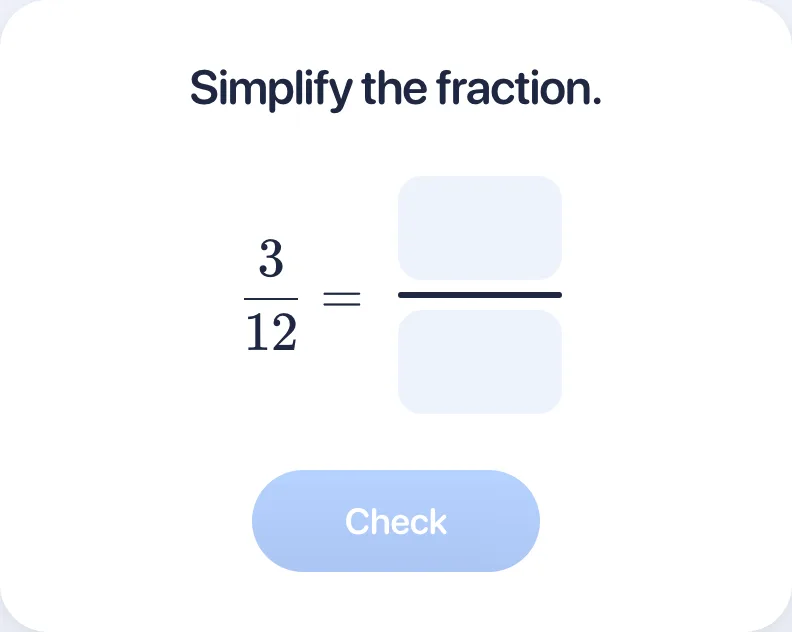
Worked examples
Simplify 10/15
Simplify 18/24
Simplify 21/28
Simplify 35/45
Can 16/27 be simplified?
Frequently asked questions
What does "simplest form" mean?
A fraction is in its simplest form (or lowest terms) when it can't be simplified any further: the only number that divides into both the numerator and the denominator is 1. Examples: 2/3, 3/4, 7/9.
When do children learn to simplify fractions?
In England, children meet equivalent fractions from Year 3, and simplifying fractions is taught in Year 5 and Year 6. In secondary school they learn to simplify in one step using the highest common factor.
Can you simplify by subtracting the same number from the top and bottom?
No. Only dividing (or multiplying) the top and bottom by the same number keeps the value of the fraction. Subtracting (6/8 → 4/6) gives a different fraction.
To revise the basics (numerator, denominator, reading a fraction), see our lesson Fractions explained simply, then how to find equivalent fractions.
Find out where your child stands in 20 minutes
The EasyMaths assessment is free: around thirty varied questions covering the whole year’s curriculum, with clear results skill by skill and the exercises to work on next.
Take the free assessment →In the curriculum: Grade 5 (Year 5) · Grade 6 (Year 6)
Keep reading
 Fractions
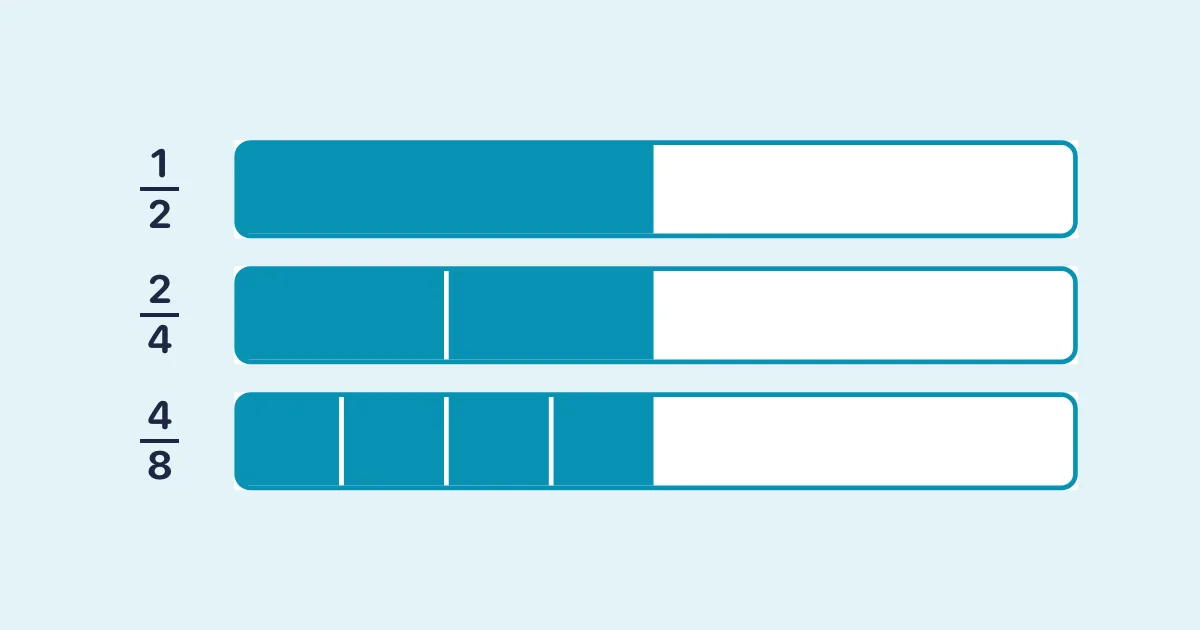
Equivalent fractions: how to find them
What are equivalent fractions and how do you find them? Multiply or divide the top and bottom by the same number. Diagrams, a table and…
 Fractions
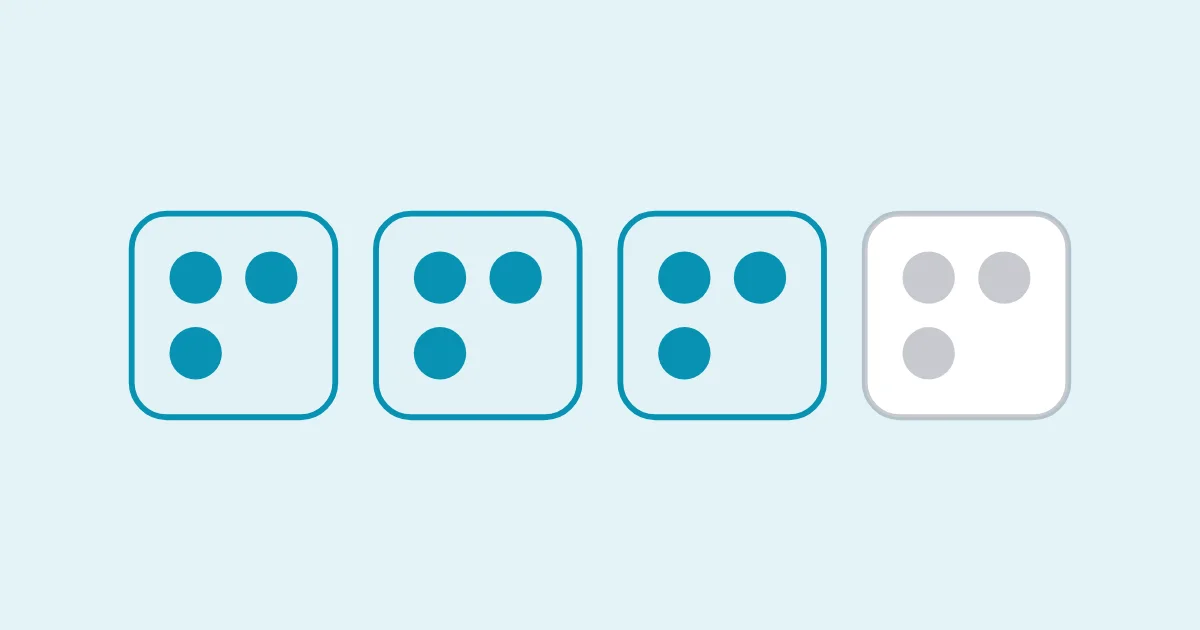
 of amounts: how to find 3/4 of 12
How to find a fraction of an amount: divide by the bottom number, multiply by the top. Why it works, the bar model, word problems and…
 Fractions
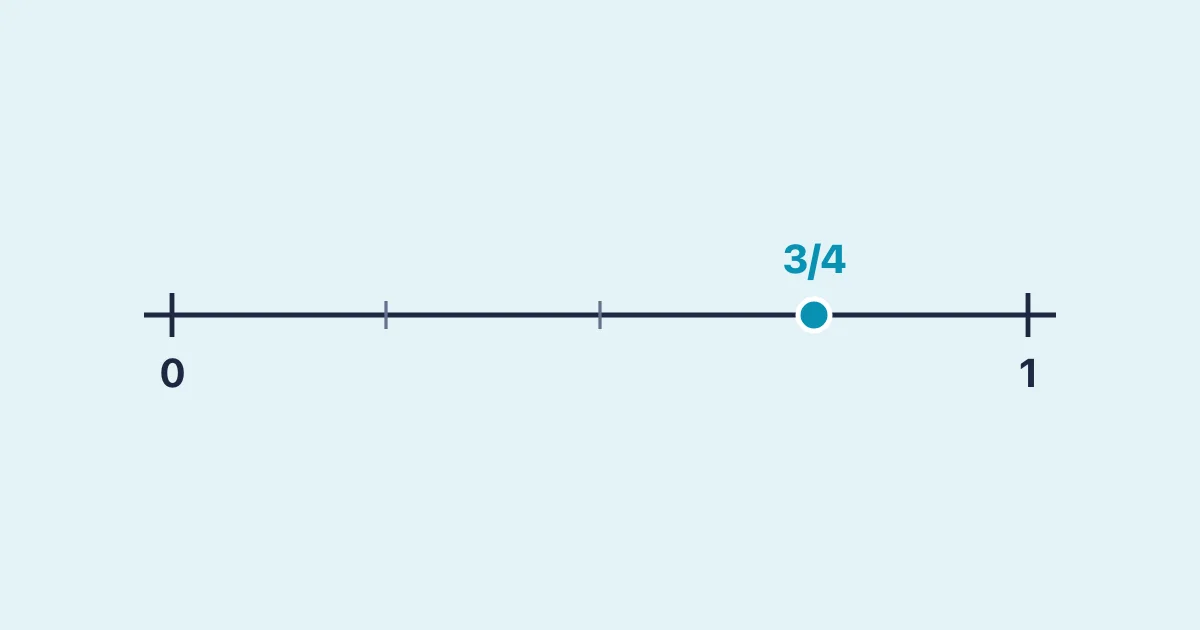
How to put fractions on a number line
How to place a fraction on a number line: find the whole, count the equal parts, then count along. Fractions greater than 1, diagrams…