Step 1: find the whole
On a number line, one whole is the distance from 0 to 1. Every fraction is placed in relation to it. Before anything else, get your child to put a finger on 0, then on 1.
Step 2: count the parts between 0 and 1
Count the spaces (the "jumps") between 0 and 1, not the marks! If there are 3 little marks between 0 and 1, there are 4 spaces: each jump is worth 14.
Step 3: count along the numerator
To place 34, start at 0 and make 3 jumps of 14. Stop on the third mark. Encourage your child to count out loud: "one quarter, two quarters, three quarters".
Fractions greater than 1
A fraction like 53 is greater than 1 (because 5 > 3). These are called improper fractions, and you place them in exactly the same way: each jump is 13, and you make 5 of them, even if it takes you past 1.
Notice that 33 lands exactly on 1, and 63 exactly on 2. Makes sense: 33 = 1 and 63 = 2.
When the marks don't match the denominator
Sometimes you have to place 12 on a line marked in quarters, or 23 on a line marked in sixths. That's where equivalent fractions come in:
- 12 = 24: on a line in quarters, count along 2 marks.
- 23 = 46: on a line in sixths, count along 4 marks.
See our article equivalent fractions.
Reading a fraction from a number line
The reverse question is just as common: a point is marked and you have to write the fraction.
- Count the jumps between 0 and 1 → that's the denominator.
- Count the jumps from 0 to the point → that's the numerator.
If the whole is split into 5 and the point is on the 7th jump, the fraction is 75.
How to explain it to your child
- Make a "fraction ruler" from a paper strip 12 cm long, from 0 to 1: folding it into 2, 3, 4 or 6 lets your child create the marks themselves.
- Get them to make the jumps with a finger, counting out loud: "one sixth, two sixths…".
- Link it to a real ruler or tape measure: between 0 and 1 cm there are 10 millimetres, so each millimetre is 110 of a centimetre.
- Use benchmark fractions: 12 is always halfway along the whole.
The most common mistakes
- Counting marks instead of spaces.
- Starting from 1 instead of 0, or from the first mark.
- Using the wrong whole, when the line starts at a number other than 0, or goes up to 2 or 3.
- Placing 53 before 1 because they don't think they're allowed to go past the whole.
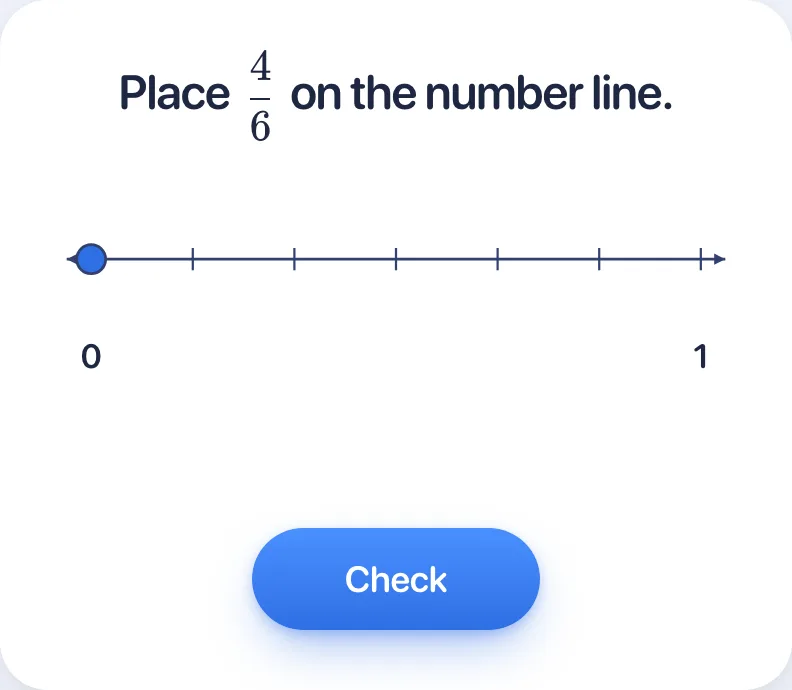
Worked examples
The whole is split into 5. Where does 2/5 go?
The whole is split into 4. Where does 7/4 go?
The line is marked in tenths. Where does 1/2 go?
The whole is split into 8 and the point is on the 3rd jump. What fraction is it?
Frequently asked questions
How do you know how many parts the whole is split into?
Count the spaces (not the marks) between 0 and 1. If there are 3 marks between 0 and 1, the whole is split into 4 parts.
How do you place a fraction greater than 1?
In the same way: count along as many parts as the numerator, even past 1. You can also split it up: 7/4 = 1 + 3/4, so go to 1 and count on 3 quarters.
When do children learn fractions on a number line?
In England, children count in simple fractions on a number line from Year 2 and Year 3, and work with improper fractions and mixed numbers in Year 5.
Keep reading: how to order fractions and our lesson Fractions explained simply.
Find out where your child stands in 20 minutes
The EasyMaths assessment is free: around thirty varied questions covering the whole year’s curriculum, with clear results skill by skill and the exercises to work on next.
Take the free assessment →In the curriculum: Grade 3 (Year 3) · Grade 4 (Year 4) · Grade 5 (Year 5)
Keep reading
 Fractions
How to compare fractions
How to compare two fractions: same denominator, same numerator, different denominators, or compared with 1. Diagrams, a clear method and…
 Fractions
How to order fractions from smallest to largest
How to put fractions in order, from smallest to largest (ascending) or largest to smallest (descending): a 3-step method, the number…
 Fractions
How to work out percentages
How to work out percentages in your head: what 'per cent' means, finding 50%, 25%, 10% and 1%, building any percentage from them, and…