Case 1: the fractions have the same denominator
This is the easiest case. 38 and 58 are both eighths: the pieces are the same size, so whichever has more pieces is bigger.
So 38 < 58, because 3 < 5.
Case 2: the fractions have the same numerator
This is where children slip up most. Compare 13 and 15. Many say "15 is bigger, because 5 is bigger than 3". That's wrong!
Sharing a pizza between 3 people gives bigger slices than sharing it between 5. So 13 > 15. The rule: when the numerators are the same, the bigger fraction is the one with the smaller denominator.
Case 3: comparing a fraction with 1
Before doing any calculation, this check settles lots of questions:
- If the numerator is smaller than the denominator, the fraction is less than 1: 34 < 1.
- If they are equal, the fraction equals 1: 55 = 1.
- If the numerator is bigger, the fraction is greater than 1: 74 > 1.
So 76 must be bigger than 910: the first is more than 1, the second isn't. No calculation needed.
Case 4: different denominators
Compare 23 and 34. The pieces aren't the same size, so we can't just count. We cut both fractions into pieces of the same size: in other words, we give them a common denominator.
- Find a common denominator: a number in both the 3 times table and the 4 times table. Here, 12 (3 × 4 = 12).
- Convert each fraction, multiplying the top and bottom by the same number:
- 23 = 812 (multiply by 4),
- 34 = 912 (multiply by 3).
- Compare the numerators: 8 < 9, so 23 < 34.
The "half" shortcut
To go faster, compare each fraction with 12. A fraction is bigger than a half if its numerator is more than half its denominator:
- 47 > 12 (because 4 > 3.5),
- 38 < 12 (because 3 < 4).
So 47 > 38, without finding any common denominator.
How to explain it to your child
- Use paper strips of the same length. Fold one into 3, the other into 4, shade 23 and 34, and lay them side by side. The comparison is obvious.
- Always say what the pieces are: "eighths", "thirds". You can only compare numbers of pieces if the pieces are the same size.
- Check the Case 2 trap with real examples (sharing a cake between 2 people or between 10).
- Practise on a number line: the further right a fraction is, the bigger it is. See how to put fractions on a number line.
The most common mistakes
- Comparing denominators like whole numbers: "18 > 14 because 8 > 4". It's the other way round!
- Comparing numerators and ignoring the denominators: saying 310 > 23 because 3 > 2.
- Changing only the denominator: writing 23 = 212. You must multiply the top and the bottom.
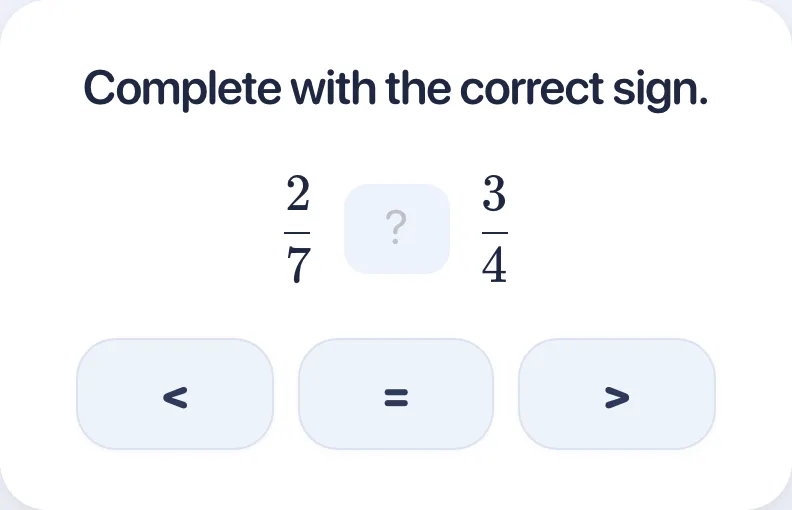
Worked examples
Compare 5/7 and 4/7
Compare 2/9 and 2/5
Compare 3/4 and 5/6
Compare 9/8 and 11/12
Compare 3/5 and 7/10
Frequently asked questions
How do you compare fractions with different denominators?
Rewrite them with the same denominator by multiplying the top and bottom of each one by the same number. For 2/3 and 3/4, change them both into twelfths: 8/12 and 9/12. Then compare the numerators.
Why is 1/3 bigger than 1/5?
Because cutting something into 3 pieces makes bigger pieces than cutting it into 5. When the numerators are the same, the fraction with the smaller denominator is the bigger one.
When do children learn to compare fractions?
In England, children compare simple fractions in Year 3 and Year 4, then fractions with different denominators in Year 5 and Year 6.
Keep reading: how to order fractions, equivalent fractions and our lesson Fractions explained simply.
Find out where your child stands in 20 minutes
The EasyMaths assessment is free: around thirty varied questions covering the whole year’s curriculum, with clear results skill by skill and the exercises to work on next.
Take the free assessment →In the curriculum: Grade 4 (Year 4) · Grade 5 (Year 5) · Grade 6 (Year 6)
Keep reading
 Fractions
How to order fractions from smallest to largest
How to put fractions in order, from smallest to largest (ascending) or largest to smallest (descending): a 3-step method, the number…
 Fractions
How to work out percentages
How to work out percentages in your head: what 'per cent' means, finding 50%, 25%, 10% and 1%, building any percentage from them, and…
 Fractions
How to simplify fractions
To simplify a fraction, divide the top and bottom by the same number. A clear step-by-step method, divisibility tricks, diagrams and…