Seeing that two fractions are equal
Take three strips of the same length. Cut the first into 2, the second into 4 and the third into 8. Shade half of each:
It's exactly the same amount of strip. Only the cutting changes: more pieces, but smaller pieces. That's the whole idea behind equivalent fractions.
The rule: multiply the top and bottom by the same number
If you multiply the denominator by 2, you cut every piece in half: there are twice as many pieces. To keep the same amount, you need twice as many pieces, so you multiply the numerator by 2 as well.
34 = 68 (× 2) = 912 (× 3) = 1216 (× 4)
You can also divide the top and bottom by the same number: that's called simplifying (68 = 34). See our article how to simplify fractions.
The most common fraction families
| Fraction | Equivalent fractions |
|---|---|
| 12 | 24, 36, 48, 510, 50100 |
| 13 | 26, 39, 412, 1030 |
| 14 | 28, 312, 25100 |
| 34 | 68, 912, 75100 |
| 15 | 210, 20100 |
Finding the missing number
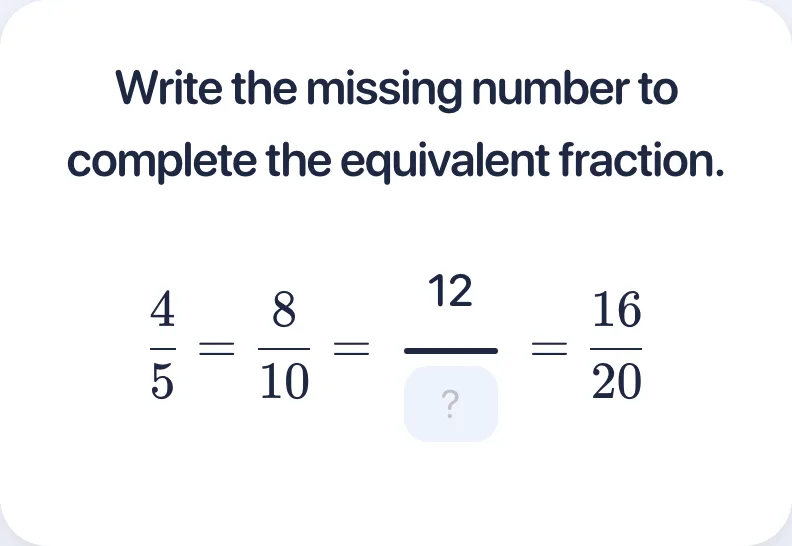
A very common question: complete 23 = ?12.
- Look at the denominators: to get from 3 to 12, you multiply by 4 (3 × 4 = 12).
- Do the same to the top: 2 × 4 = 8.
- So 23 = 812.
It works the other way too: 1520 = ?4. To get from 20 to 4, you divide by 5; so 15 ÷ 5 = 3, and 1520 = 34.
On a number line
Equivalent fractions sit at exactly the same point on a number line. Here, 34 and 68 land in the same place:
How to check whether two fractions are equivalent
Two methods, depending on age:
- At primary school: look for the number you multiplied by. 46 and 1015? You can't get from one to the other directly, but both simplify to 23, so they're equivalent.
- The grown-up shortcut: cross-multiply. ab and cd are equivalent if a × d = b × c. For 46 and 1015: 4 × 15 = 60 and 6 × 10 = 60. They match, so the fractions are equivalent.
How to explain it to your child
- Fold a sheet of paper in half, shade one half, then fold it into quarters, then eighths: the shaded part doesn't change, but it becomes 12, then 24, then 48.
- Link it to times tables: the list 13, 26, 39, 412… is the 1 times table on top and the 3 times table underneath.
- Repeat the golden rule: "whatever I do to the bottom, I do to the top".
The most common mistakes
- Adding instead of multiplying: 12 is not equal to 23 (we added 1 to the top and bottom).
- Multiplying only the denominator: 12 is not equal to 14.
- Using the wrong multiplier: for 23 = ?12, multiplying 2 by 12 instead of 4.
Worked examples
Complete: 1/4 = ?/12
Complete: 3/5 = 9/?
Complete: 12/16 = ?/4
Are 2/5 and 6/15 equivalent?
Are 3/4 and 4/5 equivalent?
Frequently asked questions
What are equivalent fractions?
Fractions that look different but are worth the same amount, like 1/2, 2/4 and 4/8. You get one from another by multiplying or dividing the numerator and denominator by the same number.
How do you find an equivalent fraction to 1/2?
Multiply the top and bottom by the same number: 2/4 (× 2), 3/6 (× 3), 4/8 (× 4), 5/10 (× 5)… A fraction equals 1/2 when its denominator is double its numerator.
When do children learn equivalent fractions?
In England, children start recognising equivalent fractions in Year 2 and Year 3 (for example 2/4 = 1/2), then work with them more formally in Year 4 to Year 6.
Keep reading: how to compare fractions and our lesson Fractions explained simply.
Find out where your child stands in 20 minutes
The EasyMaths assessment is free: around thirty varied questions covering the whole year’s curriculum, with clear results skill by skill and the exercises to work on next.
Take the free assessment →In the curriculum: Grade 4 (Year 4) · Grade 5 (Year 5) · Grade 6 (Year 6)
Keep reading
 Fractions
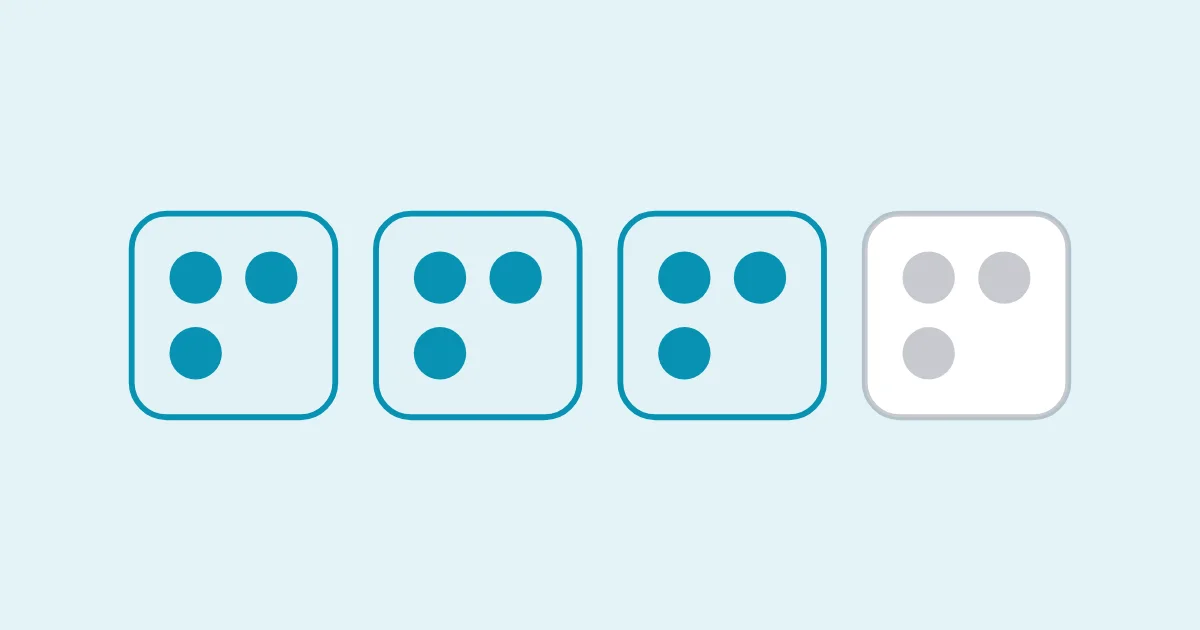
 of amounts: how to find 3/4 of 12
How to find a fraction of an amount: divide by the bottom number, multiply by the top. Why it works, the bar model, word problems and…
 Fractions
How to put fractions on a number line
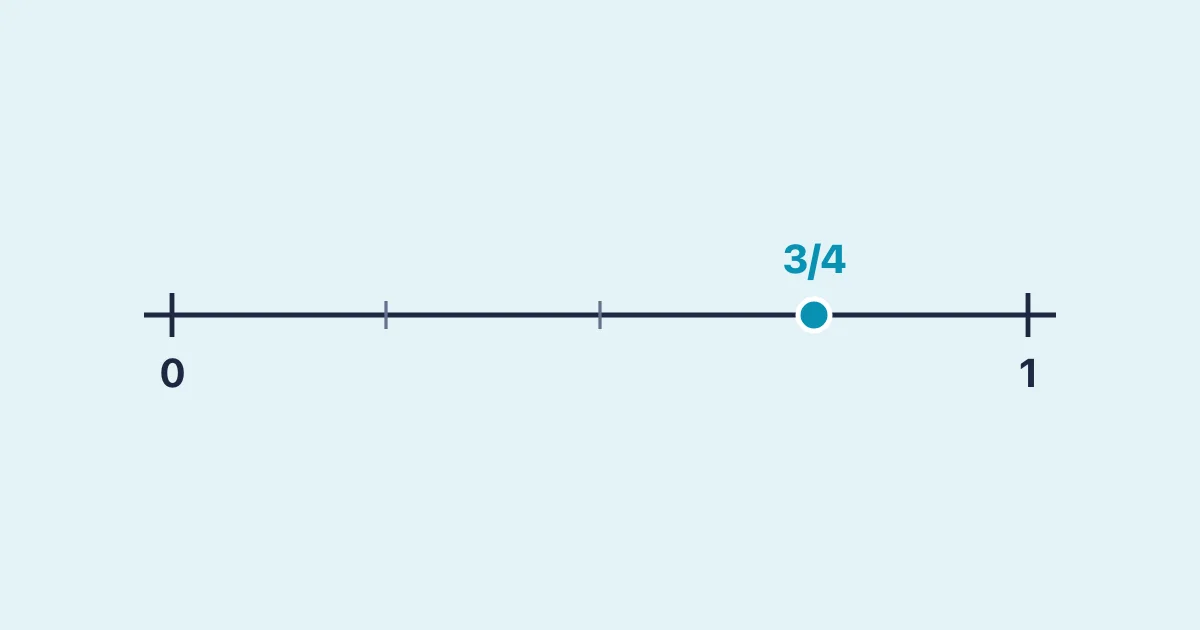
How to place a fraction on a number line: find the whole, count the equal parts, then count along. Fractions greater than 1, diagrams…
 Fractions
How to compare fractions
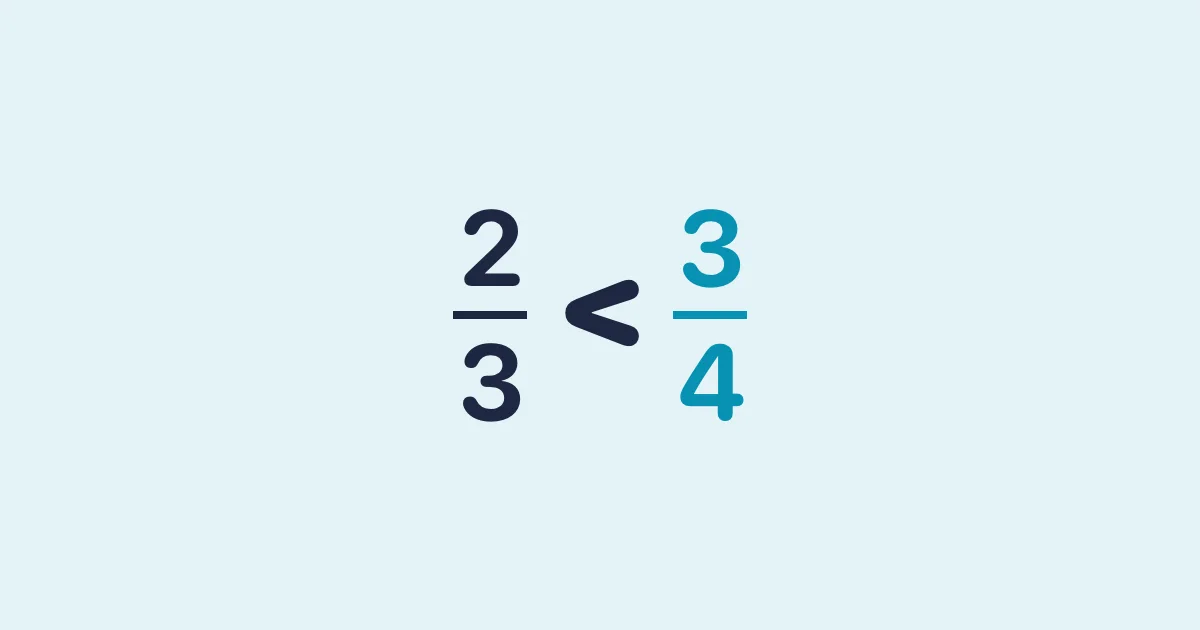
How to compare two fractions: same denominator, same numerator, different denominators, or compared with 1. Diagrams, a clear method and…