What does "per cent" mean?
The word comes from the Latin per centum, "for each hundred". 25% means 25 out of every 100. On a grid of 100 squares, colour 25 and you've coloured 25%: which is also a quarter of the grid:
So a percentage is simply a fraction out of 100: 25% = 25/100 = 1/4.
The key percentages to know
| Percentage | Fraction | How to find it |
|---|---|---|
| 100% | the whole | the amount itself |
| 50% | 1/2 | divide by 2 |
| 25% | 1/4 | divide by 4 (or halve twice) |
| 75% | 3/4 | find 25%, then × 3 |
| 10% | 1/10 | divide by 10 |
| 20% | 1/5 | find 10%, then × 2 |
| 5% | 1/20 | half of 10% |
| 1% | 1/100 | divide by 100 |
The 10% method: the most useful of all
Almost every percentage can be built from 10%:
Example: 30% of 60
- 10% of 60 = 60 ÷ 10 = 6
- 30% = 3 × 10%, so 3 × 6 = 18
Example: 15% of 40
- 10% of 40 = 4
- 5% is half of 10%: 2
- 15% = 10% + 5% = 4 + 2 = 6
Example: 35% of 200
- 10% = 20, so 30% = 60
- 5% = 10
- 35% = 60 + 10 = 70
Using fractions
When the percentage matches a simple fraction, go straight there:
- 50% of 36 = half of 36 = 18;
- 25% of 80 = a quarter of 80 = 20;
- 75% of 40: a quarter is 10, so three quarters = 30.
See also how to find fractions of amounts: it's exactly the same skill.
Discounts: a real-life example
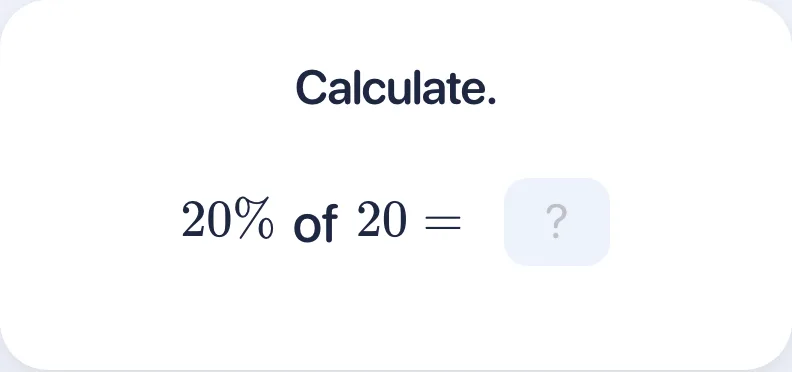
A £40 jumper has 20% off in the sale. How much does it cost?
- 10% of £40 = £4, so 20% = £8 (that's the discount).
- New price: £40 − £8 = £32.
Children love this kind of problem, especially with prices from their favourite shops.
Writing one number as a percentage of another
Sometimes the question is the other way round: "Sam scored 18 out of 20 in a test. What percentage is that?"
- Turn it into a fraction out of 100: 18/20 = 90/100 (multiply top and bottom by 5).
- So Sam scored 90%.
How to explain it to your child
- Start with the 100 square: colour 50, 25, 10 squares and name the percentages.
- Use money: 10% of £1 is 10p; 50% of £10 is £5.
- Look at sales signs in shops and work out the discount together.
- Always build from 10%, 50% and 25% rather than learning a formula.
The most common mistakes
- Thinking a percentage is always "out of 100" items: 25% of 80 is not 25.
- Dividing by the percentage: 20% of 40 = 40 ÷ 20 = 2 (wrong: it's 8).
- Forgetting to subtract in a discount: the price after 20% off £40 is £32, not £8.
- Getting 5% wrong: it's half of 10%, not 10% ÷ 5.
Worked examples
50% of 90
10% of 250
25% of 60
40% of 30
A £60 game has 25% off. What is the new price?
Frequently asked questions
How do you work out a percentage of a number?
Start from 10% (divide by 10), 50% (halve) or 25% (divide by 4), then build the percentage you need. For 30% of 60: 10% is 6, so 30% is 18.
How do you find 10% of a number?
Divide it by 10: the digits move one place to the right. 10% of 80 is 8 and 10% of 45 is 4.5.
When do children learn percentages?
In England, percentages are introduced in Year 5 (linking them to fractions out of 100) and children find percentages of amounts in Year 6.
Keep reading: our lesson Proportionality and how to find fractions of amounts.
Find out where your child stands in 20 minutes
The EasyMaths assessment is free: around thirty varied questions covering the whole year’s curriculum, with clear results skill by skill and the exercises to work on next.
Take the free assessment →In the curriculum: Grade 5 (Year 5) · Grade 6 (Year 6)
Keep reading
 Fractions
How to simplify fractions
To simplify a fraction, divide the top and bottom by the same number. A clear step-by-step method, divisibility tricks, diagrams and…
 Fractions
Equivalent fractions: how to find them
What are equivalent fractions and how do you find them? Multiply or divide the top and bottom by the same number. Diagrams, a table and…
 Fractions
 of amounts: how to find 3/4 of 12
How to find a fraction of an amount: divide by the bottom number, multiply by the top. Why it works, the bar model, word problems and…