Standard partitioning
Read the number digit by digit, giving each one its true value:
| thousands | hundreds | tens | ones |
|---|---|---|---|
| 3 | 4 | 7 | |
| 2 | 5 | 6 | 8 |
- 347 = 300 + 40 + 7
- 2,568 = 2,000 + 500 + 60 + 8
This way of writing a number is also called expanded form.
Using the words hundreds, tens and ones
Same idea, naming the places:
- 347 = 3 hundreds + 4 tens + 7 ones
- 2,568 = 2 thousands + 5 hundreds + 6 tens + 8 ones
When there are zeros
When a digit is 0, there's nothing in that place:
- 305 = 300 + 5 (no tens)
- 4,060 = 4,000 + 60 (no hundreds and no ones)
The other way round is where children slip up most: 300 + 5 isn't 35, it's 305. The zero holds the place of the empty tens.
Other ways to partition
The same number can be partitioned in several ways, and exercises often ask for this:
- 347 = 34 tens + 7 ones (because 340 = 34 tens)
- 347 = 3 hundreds + 47 ones
- 347 = 300 + 47 = 340 + 7 = 200 + 147…
Understanding that 347 is also 34 tens really matters: it's what makes exchanging and column subtraction possible. A classic trick question: "How many tens are there in 347?". The expected answer isn't 4 (that's the tens digit) but 34 (the number of tens).
Recombining: the reverse exercise
You're given a partition and have to find the number:
- 500 + 20 + 9 = 529
- 6 hundreds + 8 ones = 608
- 4 tens + 15 ones = 40 + 15 = 55
That last one is a trap: 15 ones is 1 ten and 5 ones. You mustn't write "415"!
How to explain it to your child
- Use money: £100 notes (pretend ones!), £10 notes and £1 coins. £347 is three £100s, four £10s and seven £1s.
- Get them to draw numbers with squares (hundreds), sticks (tens) and dots (ones).
- Use a place value chart at first, then gradually take it away.
- Stress the difference between the tens digit and the number of tens.
The most common mistakes
- Ignoring the value of the digits: 347 = 3 + 4 + 7.
- Forgetting zeros: 300 + 5 = 35.
- Confusing "tens digit" and "number of tens".
- Recombining badly when a place goes over 9: 4 tens + 15 ones = 415.
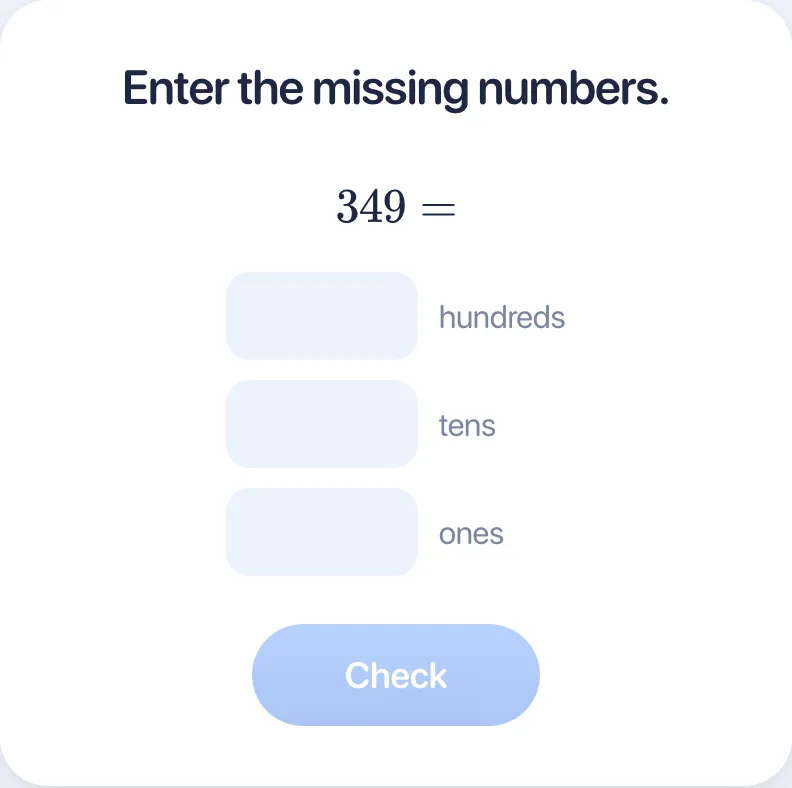
Worked examples
Partition 486
Partition 7,035
Recombine: 600 + 9
How many tens are in 253?
Recombine: 3 hundreds + 12 tens + 4 ones
Frequently asked questions
How do you partition a number into hundreds, tens and ones?
Look at each digit and its place: the right-hand digit gives the ones, the next one the tens, then the hundreds. 347 = 3 hundreds + 4 tens + 7 ones, or 300 + 40 + 7.
What's the difference between the tens digit and the number of tens?
The tens digit is the one in the tens place (4 in 347). The number of tens counts all the tens in the number, including those in the hundreds (34 in 347).
When do children learn to partition numbers?
In England, children partition numbers to 20 in Year 1, to 100 in Year 2, to 1,000 in Year 3 and to 10,000 in Year 4.
Keep reading: tens and ones and our lesson Place value.
Find out where your child stands in 20 minutes
The EasyMaths assessment is free: around thirty varied questions covering the whole year’s curriculum, with clear results skill by skill and the exercises to work on next.
Take the free assessment →In the curriculum: Grade 1 (Year 1) · Grade 2 (Year 2) · Grade 3 (Year 3)
Keep reading
 Place value
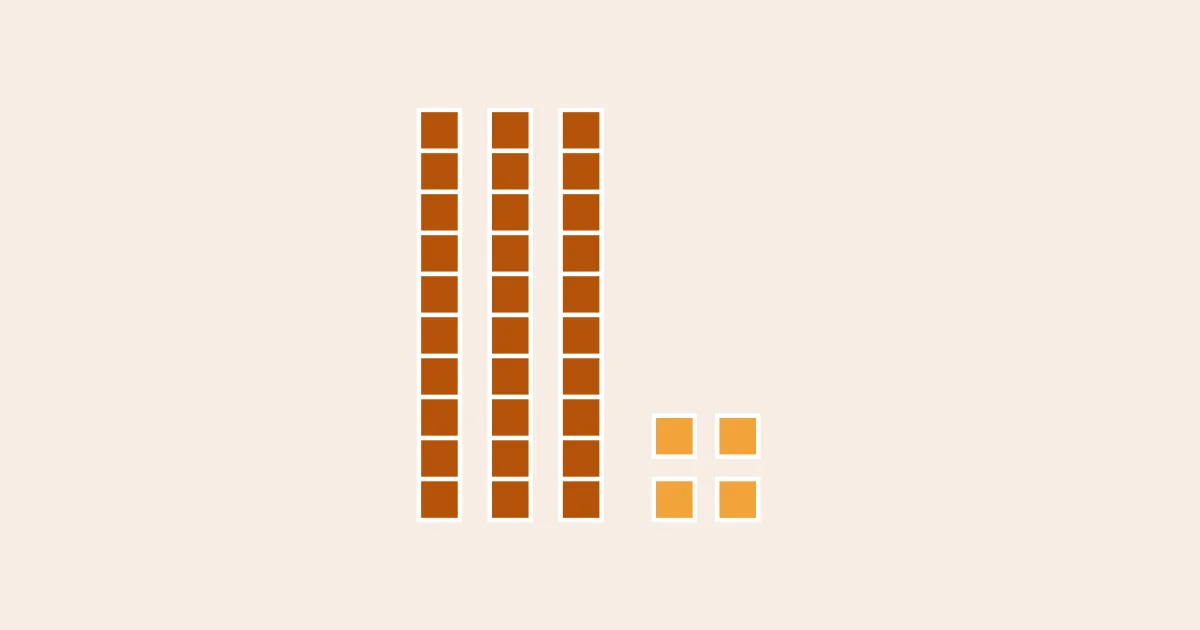
Tens and ones: how to explain place value
How to explain tens and ones (place value) to a young child: groups of ten, base ten equipment, the place value chart, zero and the…
 Place value
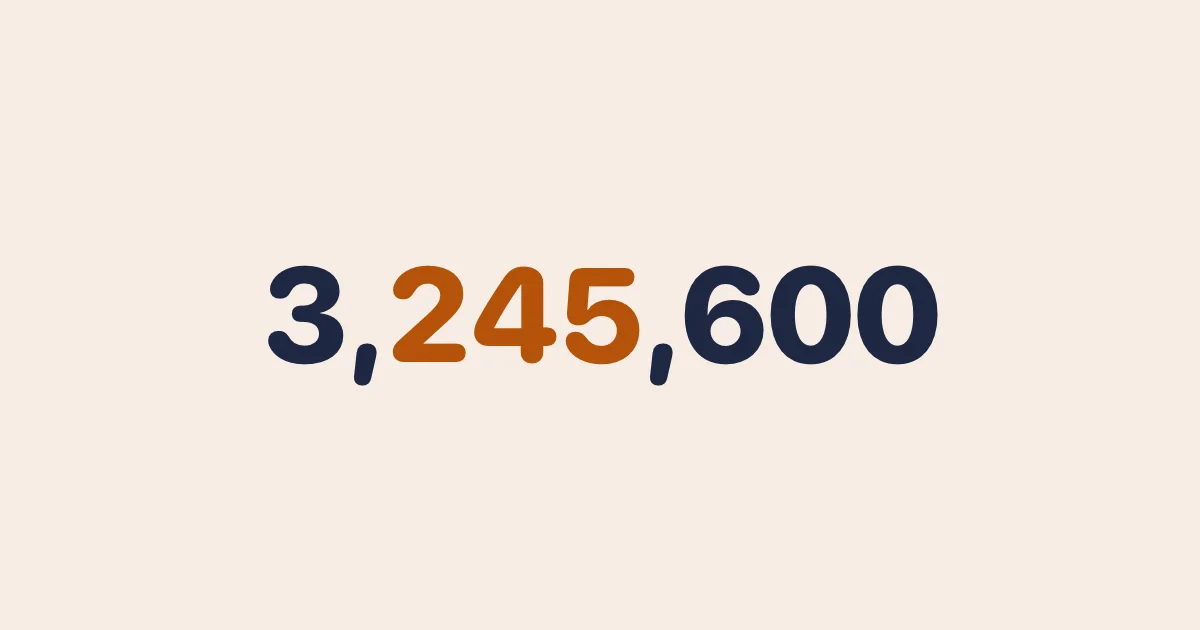
How to read large numbers
How to read and write large numbers: split them into groups of three with commas, read each group with its name (million, thousand),…
 Place value
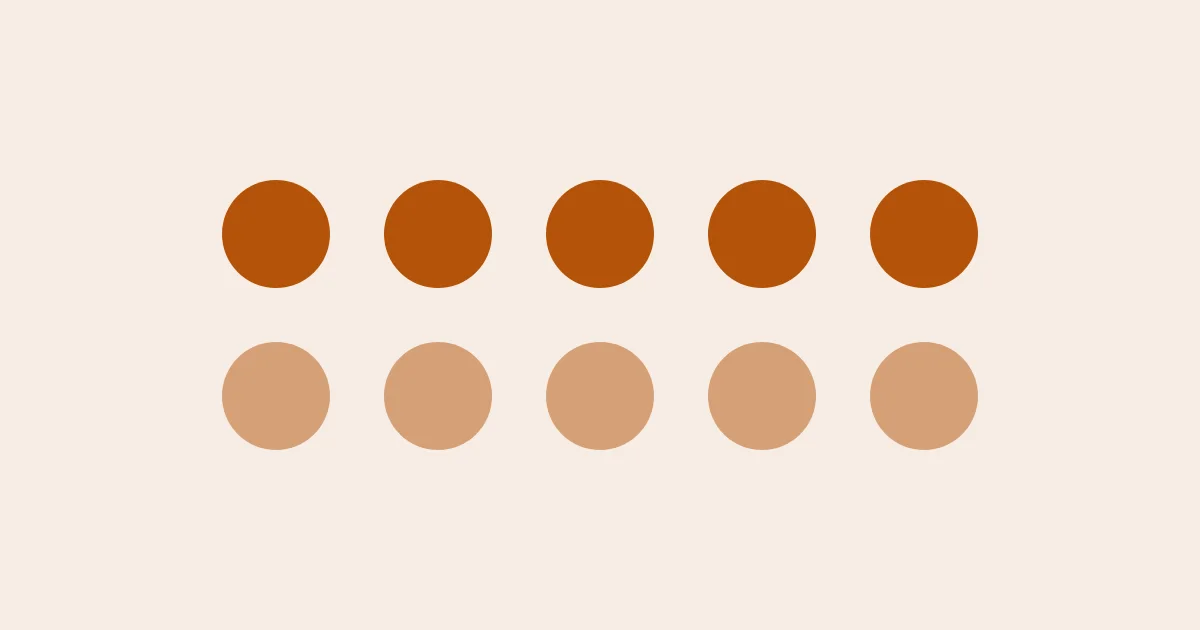
How to teach a child to count
How to teach a young child to count: why reciting isn't counting, one-to-one counting, small amounts at a glance, going past 10, games…