Why groups of three?
Our number system has a pattern that repeats every three places: hundreds, tens, ones… of ones, then of thousands, then of millions. Each group of three digits is read exactly like a number up to 999.
| H | T | O |
|---|---|---|
| 2 | 4 | 5 |
| 6 | 0 | 0 |
| Millions | Thousands | Ones |
|---|---|---|
| 3 | 245 | 600 |
| three million | two hundred and forty-five thousand | six hundred |
The method, step by step
Take 4807215, written without commas.
- Split into groups of three from the right: 4 | 807 | 215 → 4,807,215.
- Read the first group and say its name: "four million".
- Read the next group: "eight hundred and seven thousand".
- Read the last group: "two hundred and fifteen".
Answer: four million, eight hundred and seven thousand, two hundred and fifteen.
Commas or spaces?
In the UK, large numbers are usually written with commas (3,245,600). You'll sometimes see spaces instead (3 245 600), especially in science. Either way, the groups of three are the same. Just don't confuse the comma with the decimal point: 3,245 is three thousand two hundred and forty-five, while 3.245 is just over three.
Numbers with zeros
Zeros are where children slip up most. A zero shows that a place is empty, and it must still be written:
- 2,005 = two thousand and five (no hundreds, no tens)
- 40,060 = forty thousand and sixty
- 1,000,300 = one million, three hundred (the whole thousands group is empty)
The other way round, writing in figures, needs care: "three million and fifty" is 3,000,050: every group must have three digits, padded with zeros.
How big is a million?
It helps to give children a sense of size:
- 1,000 seconds is about 17 minutes;
- 1,000,000 seconds is about 11.5 days;
- a football stadium holds about 50,000 people;
- the UK has about 69 million inhabitants.
How to explain it to your child
- Use a place value chart with columns grouped in threes.
- Read numbers in the real world: populations, distances to planets, house prices, football attendances.
- Practise grouping: give them numbers without commas and ask them to add them.
- Do dictations: you read a number out, they write it in figures (zeros included!).
The most common mistakes
- Grouping from the left instead of the right.
- Leaving out zeros: "two thousand and five" written as 205 or 25.
- Reading digit by digit: "two, four, five…" instead of "two hundred and forty-five thousand".
- Mixing up commas and decimal points.
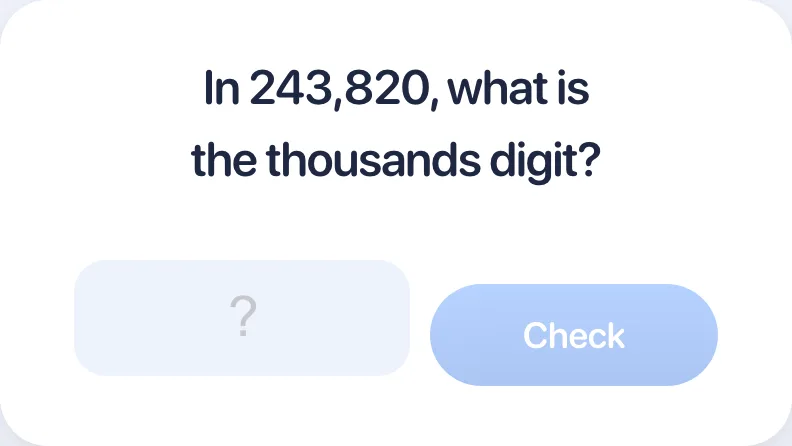
Worked examples
Read 56,302
Read 7,040,000
Add the commas: 1250800
Write in figures: two hundred thousand and nine
What is the value of the 4 in 3,245,600?
Frequently asked questions
How do you read a big number?
Split it into groups of three digits from the right (using the commas). Read each group as a number up to 999, followed by its name: million, thousand, then nothing for the last group.
Why do we put commas in large numbers?
Commas separate the groups of three digits (ones, thousands, millions), which makes large numbers much easier to read at a glance.
When do children learn to read large numbers?
In England, children read and write numbers to 10,000 in Year 4, to 1,000,000 in Year 5 and to 10,000,000 in Year 6.
Keep reading: how to write numbers in words and our lesson Place value.
Find out where your child stands in 20 minutes
The EasyMaths assessment is free: around thirty varied questions covering the whole year’s curriculum, with clear results skill by skill and the exercises to work on next.
Take the free assessment →In the curriculum: Grade 3 (Year 3) · Grade 4 (Year 4) · Grade 5 (Year 5)
Keep reading
 Place value
How to teach a child to count
How to teach a young child to count: why reciting isn't counting, one-to-one counting, small amounts at a glance, going past 10, games…
 Place value
How to write numbers in words
How to write numbers in words in British English: tricky spellings, hyphens from 21 to 99, where 'and' goes, hundred with no s, and…
 Place value
How to tell if a number is odd or even
How to tell if a number is odd or even: just look at the last digit. Why it works, how to explain it with pairs, and the odd and even…