The units of mass
At primary school, children mainly use grams (g) and kilograms (kg), sometimes milligrams (mg) and tonnes (t):
| Unit | Symbol | Value |
|---|---|---|
| tonne | t | 1,000 kg |
| kilogram | kg | 1,000 g |
| gram | g | 1 g |
| milligram | mg | 0.001 g |
The place value chart method
Writing the number in a chart is the safest method, especially at first. Remember that 1 kg = 1,000 g, so the kilograms column is three places to the left of the grams.
Example 1: convert 2,500 g to kg
Put the ones digit of 2,500 in the grams column. The kilograms are three places to the left, so the decimal point goes just after the kg column: 2.500 kg, which is 2.5 kg (zeros at the end of a decimal can be dropped).
| kg | 100g | 10g | 1g |
|---|---|---|---|
| 2. | 5 | 0 | 0 |
Example 2: convert 750 g to kg
The kg column is empty, so write 0 in it: 0.750 kg, or 0.75 kg.
| kg | 100g | 10g | 1g |
|---|---|---|---|
| 0. | 7 | 5 | 0 |
Example 3: convert 3.2 kg to g
Put the 3 in the kg column and the 2 just after it. Fill the empty columns up to the grams with 0s: 3,200 g.
| kg | 100g | 10g | 1g |
|---|---|---|---|
| 3 | 2 | 0 | 0 |
The quick method: move the digits
Once the chart makes sense, your child can go faster:
- From g to kg (a bigger unit): divide by 1,000 → the digits move 3 places to the right. 4,800 g = 4.8 kg; 45 g = 0.045 kg.
- From kg to g (a smaller unit): multiply by 1,000 → the digits move 3 places to the left. 1.25 kg = 1,250 g; 0.6 kg = 600 g.
A simple way to check
A common-sense rule: when you change to a bigger unit, the number gets smaller (you need fewer kilos than grams to weigh the same thing). 2,500 g → 2.5 kg: the number has got smaller. If your child gets 2,500,000 kg, they'll see straight away that it's nonsense.
How to explain it to your child
- Start with kitchen packaging: a 1 kg bag of flour, a 250 g pack of butter, a 125 g yoghurt. "How many packs of butter make 1 kg?" (4, because 4 × 250 = 1,000).
- Bake together: "The recipe needs 0.5 kg of flour: how many grams on the scales?".
- Get them to draw the chart themselves and keep it handy for a few weeks.
- Stress the common-sense rule: bigger unit → smaller number.
The most common mistakes
- Going the wrong way: multiplying instead of dividing (2,500 g = 2,500,000 kg).
- Moving the digits only 1 or 2 places (45 g = 0.45 kg).
- Putting more than one digit in a column of the chart.
- Forgetting the 0 before the decimal point (writing .75 kg instead of 0.75 kg).
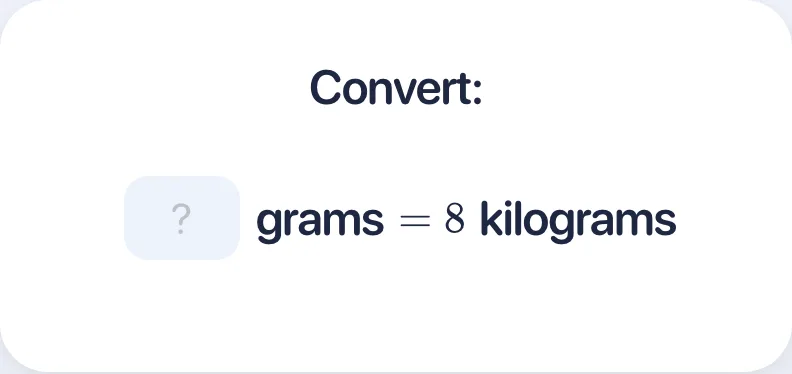
Worked examples
Convert 6,000 g to kg
Convert 1,350 g to kg
Convert 80 g to kg
Convert 2.75 kg to g
Convert 3 t to kg
Frequently asked questions
How many grams are in a kilogram?
There are 1,000 grams in a kilogram: 1 kg = 1,000 g. Half a kilogram is 500 g, and a quarter of a kilogram is 250 g.
How do you convert g to kg without a chart?
Divide by 1,000: move the digits three places to the right, adding zeros if needed. 2,500 g = 2.5 kg and 45 g = 0.045 kg.
When do children learn to convert units of mass?
In England, children measure in grams and kilograms from Year 2, and convert between units (for example kilograms and grams) in Year 4 and Year 5.
Keep reading: our lesson Units of measurement and how to convert cm to m.
Find out where your child stands in 20 minutes
The EasyMaths assessment is free: around thirty varied questions covering the whole year’s curriculum, with clear results skill by skill and the exercises to work on next.
Take the free assessment →In the curriculum: Grade 3 (Year 3) · Grade 4 (Year 4) · Grade 5 (Year 5)
Keep reading
 Measurement
How to convert hours to minutes
How to convert hours to minutes and minutes to hours: 1 hour = 60 minutes, multiplying by 60, dividing with remainders, and the 1.5…
 Measurement
How to convert litres to millilitres
How to convert litres to millilitres and back: 1 litre = 1,000 ml. Everyday examples, the place value chart, moving the digits and…
 Measurement
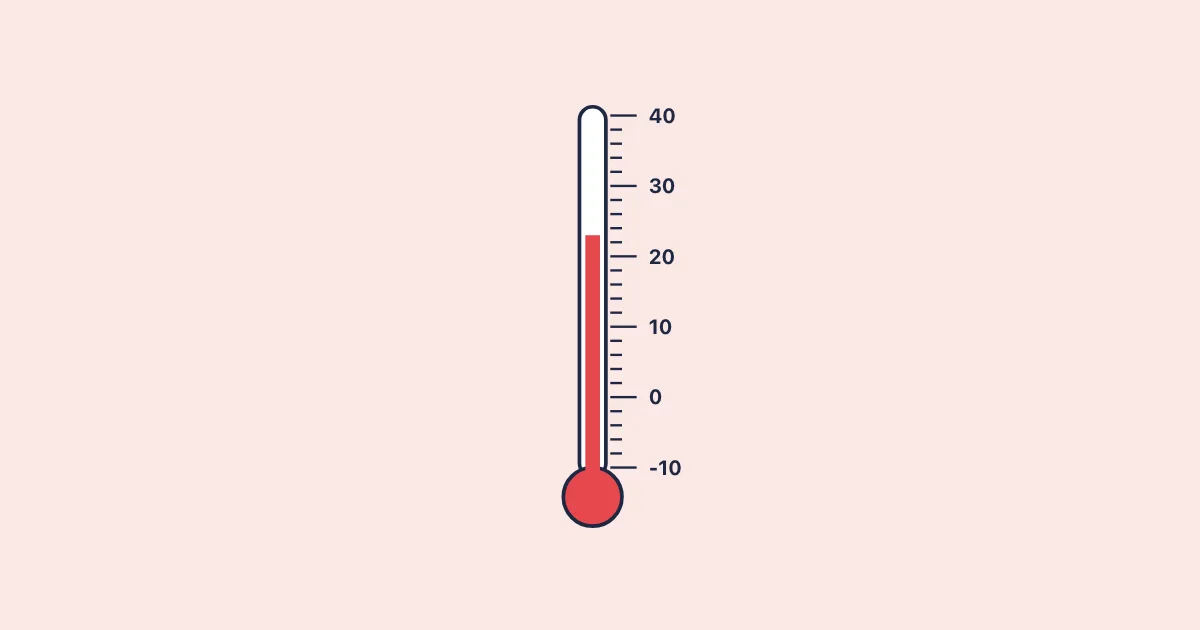
How to read a thermometer
How to read a thermometer: work out what each mark is worth, read temperatures below zero, degrees Celsius, everyday benchmarks and…