Step 1: work out what each mark is worth
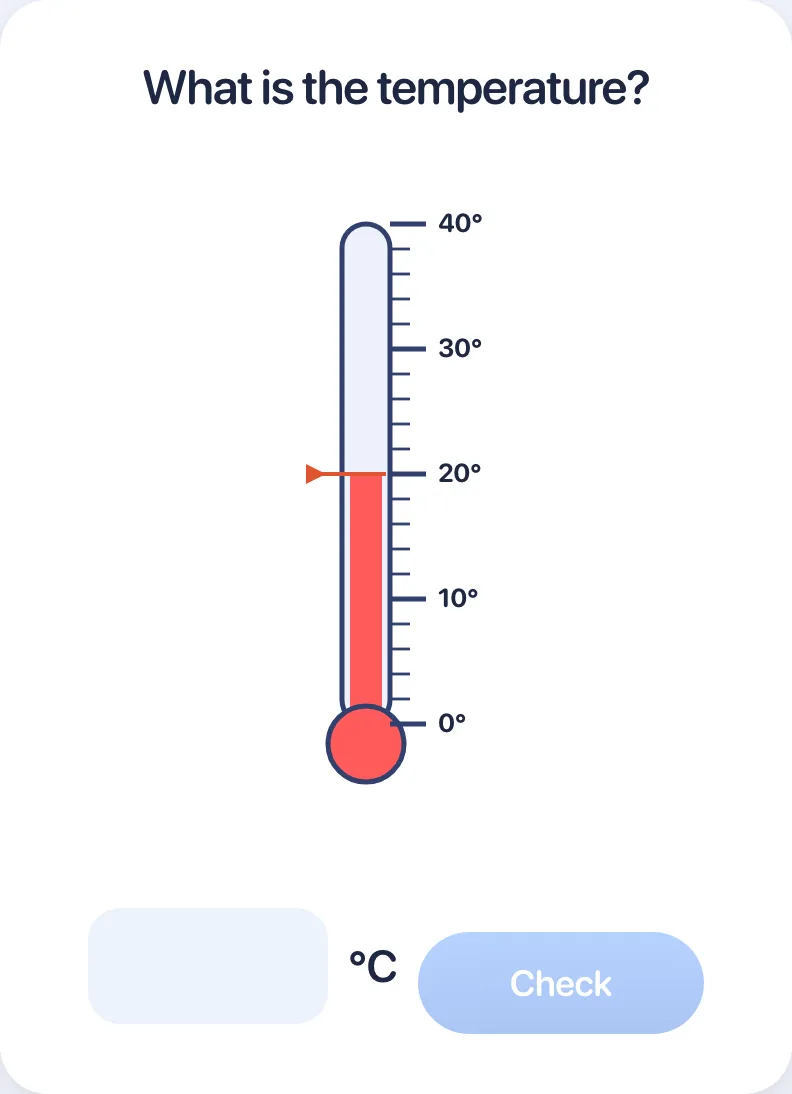
This is the most important step, and where most mistakes happen. Between 0 and 10, count the spaces (the gaps between the marks):
- if there are 10, each mark is worth 1 degree;
- if there are 5, each mark is worth 2 degrees;
- if there are 2, each mark is worth 5 degrees.
On the thermometer above, there are 5 spaces between 0 and 10: each mark is worth 2 degrees.
Step 2: read at the level of the liquid
Look exactly at the top of the column of liquid, with your eyes level with the thermometer. Start from the numbered mark just below and count the marks.
Example: the liquid is 1 mark (of 2 degrees) above 20 → 22 °C. If it stops halfway between two marks, take the value in the middle: between 22 and 24, that's 23 °C.
Temperatures below zero
When it's very cold, the liquid goes below 0. You then read negative temperatures, written with a minus sign: −5 °C is read "minus five degrees".
Watch the direction: below zero, the numbers get bigger going down. −8 °C is colder than −2 °C.
Everyday benchmarks
| Temperature | What it is |
|---|---|
| 0 °C | water freezes |
| 4 °C | inside a fridge |
| 20 °C | a warm room |
| 37 °C | normal body temperature |
| 100 °C | water boils |
These benchmarks help check a reading: a bedroom thermometer can't show 70 °C!
Working out a change in temperature
In the morning it's 4 °C, in the afternoon 15 °C: the temperature has risen by 15 − 4 = 11 degrees.
With negative temperatures, count the degrees on each side of zero: from −3 °C to 5 °C, there are 3 degrees up to 0, then 5 more up to 5: a difference of 8 degrees.
How to explain it to your child
- Use a real thermometer (outdoor, bath, fridge) and read the temperature every day.
- Keep a little table of the week's temperatures and compare them.
- Link it to number lines: a thermometer is just a vertical number line.
- Watch the weather forecast together: winter's negative temperatures make it real.
The most common mistakes
- Assuming each mark is worth 1 without checking.
- Counting marks instead of spaces.
- Misreading below zero: reading −2 instead of −8, or forgetting the minus sign.
- Reading at the wrong level (not exactly at the top of the liquid).
Worked examples
Between 0 and 10 there are 10 spaces. What is each mark worth?
Between 10 and 20 there are 5 spaces. The liquid is 3 marks above 10. What's the temperature?
It's −4 °C in the morning and 6 °C in the afternoon. What's the difference?
Which is colder: −7 °C or −2 °C?
Frequently asked questions
How do you know what each mark on a thermometer is worth?
Pick two numbered marks, such as 0 and 10, and count the spaces between them. If there are 5, each mark is worth 10 ÷ 5 = 2 degrees.
How do you read a negative temperature?
Below zero, count the marks downwards and write the answer with a minus sign: −5 °C is read "minus five degrees". The bigger the number after the minus sign, the colder it is.
When do children learn to read thermometers?
In England, children read scales from Year 2 and Year 3, and work with negative numbers in temperature contexts in Year 4 to Year 6.
Keep reading: how to put fractions on a number line and our lesson Units of measurement.
Find out where your child stands in 20 minutes
The EasyMaths assessment is free: around thirty varied questions covering the whole year’s curriculum, with clear results skill by skill and the exercises to work on next.
Take the free assessment →In the curriculum: Grade 3 (Year 3) · Grade 4 (Year 4) · Grade 5 (Year 5)
Keep reading
 Measurement
How to convert cm to m (and m to cm)
How to convert cm to m and m to cm: 1 m = 100 cm, the place value chart, moving the digits, plus millimetres and kilometres. With worked…
 Measurement
How to convert grams to kilograms
How to convert grams to kilograms and kilograms to grams: 1 kg = 1,000 g, the place value chart method, moving the digits, everyday…
 Measurement
How to convert hours to minutes
How to convert hours to minutes and minutes to hours: 1 hour = 60 minutes, multiplying by 60, dividing with remainders, and the 1.5…