Sorting by sides
| Triangle | Sides | Angles | Lines of symmetry |
|---|---|---|---|
| equilateral | 3 equal sides | 3 equal angles (60°) | 3 |
| isosceles | 2 equal sides | 2 equal angles | 1 |
| scalene | no equal sides | all different | 0 |
On diagrams, equal sides are shown with small marks (dashes): sides with the same number of dashes are the same length.
Sorting by angles
| Triangle | Angles |
|---|---|
| acute-angled | all three angles less than 90° |
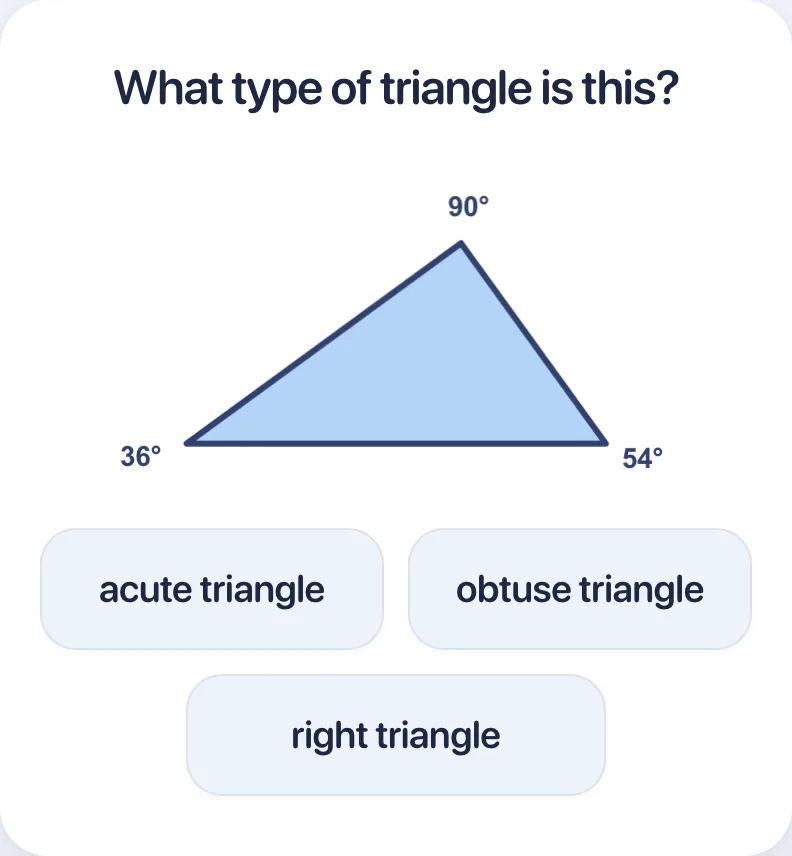
| right-angled | one angle of exactly 90° |
| obtuse-angled | one angle of more than 90° |
The two ways of sorting can be combined: a triangle can be right-angled and isosceles at the same time (it has a right angle and two equal sides: like half a square cut along its diagonal).
The 180° rule
The three angles of any triangle always add up to 180°. A lovely way to show it: draw a triangle on paper, tear off the three corners and put them side by side: they make a straight line (180°).
This lets you find a missing angle: if two angles are 50° and 70°, the third is 180° − 50° − 70° = 60°.
It also explains why an equilateral triangle has three angles of 60° (180 ÷ 3), and why a triangle can't have two right angles (90 + 90 = 180, leaving nothing for the third angle).
How to recognise a triangle
- Measure the three sides with a ruler (or look for the dashes on the diagram).
- Check for a right angle with a set square or the corner of a sheet of paper.
- Name it: by its sides, and if needed by its angles.
How to explain it to your child
- Make triangles with straws or sticks of different lengths: three equal straws always give an equilateral triangle.
- Fold a square along its diagonal: two right-angled isosceles triangles.
- Tear off the corners to discover the 180° rule.
- Hunt for triangles in the real world: road signs, roofs, sandwiches cut in half.
The most common mistakes
- Thinking a triangle must be "pointing up" to be isosceles or equilateral: turning it doesn't change its type.
- Thinking a right-angled triangle can't be isosceles.
- Mixing up isosceles and equilateral.
- Forgetting that the angles add up to 180° when finding a missing angle.
Worked examples
A triangle has sides of 5 cm, 5 cm and 5 cm. What type is it?
A triangle has sides of 4 cm, 6 cm and 4 cm. What type is it?
Two angles of a triangle are 90° and 35°. What is the third?
Can a triangle have angles of 100° and 90°?
Frequently asked questions
What are the different types of triangles?
By their sides: equilateral (3 equal sides), isosceles (2 equal sides) and scalene (no equal sides). By their angles: acute-angled, right-angled (one 90° angle) and obtuse-angled.
What do the angles in a triangle add up to?
Always 180°. If you know two angles, subtract them from 180° to find the third.
Can a triangle be both right-angled and isosceles?
Yes: it has one right angle and two equal sides, and its other two angles are 45° each. You get one by cutting a square along its diagonal.
Keep reading: how to use a protractor and our lesson 2D shapes.
Find out where your child stands in 20 minutes
The EasyMaths assessment is free: around thirty varied questions covering the whole year’s curriculum, with clear results skill by skill and the exercises to work on next.
Take the free assessment →In the curriculum: Grade 3 (Year 3) · Grade 4 (Year 4) · Grade 5 (Year 5) · Grade 6 (Year 6)
Keep reading
 Geometry
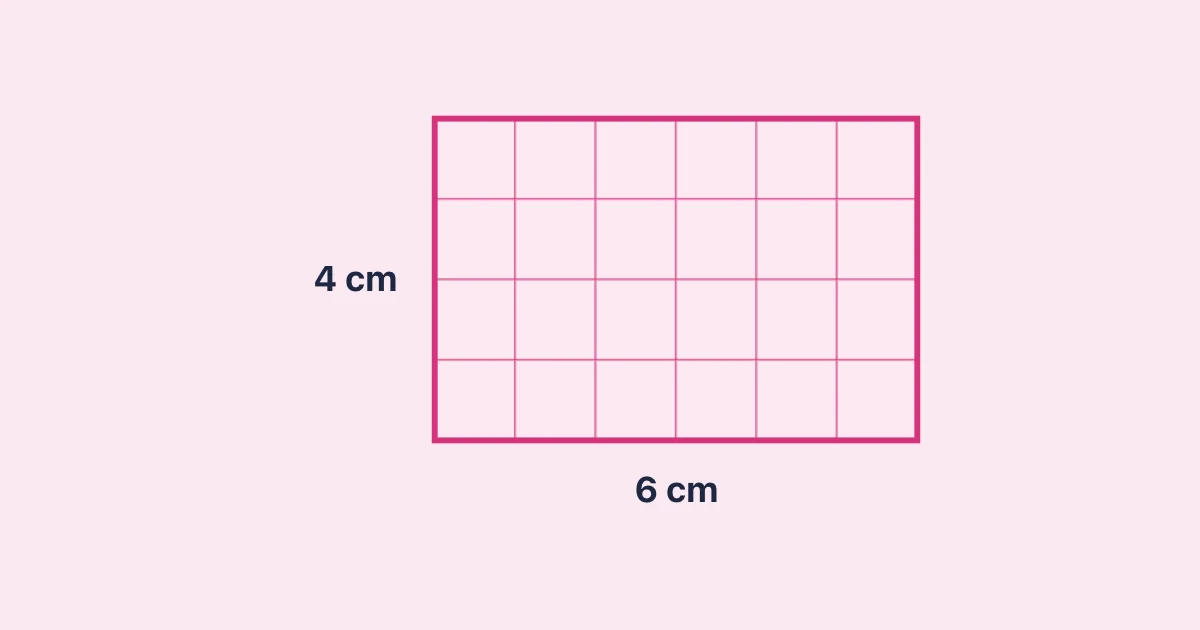
How to find the area of a rectangle
How to find the area of a rectangle: length × width, in cm² or m². Why the formula works, area vs perimeter, diagrams and worked examples.
 Geometry
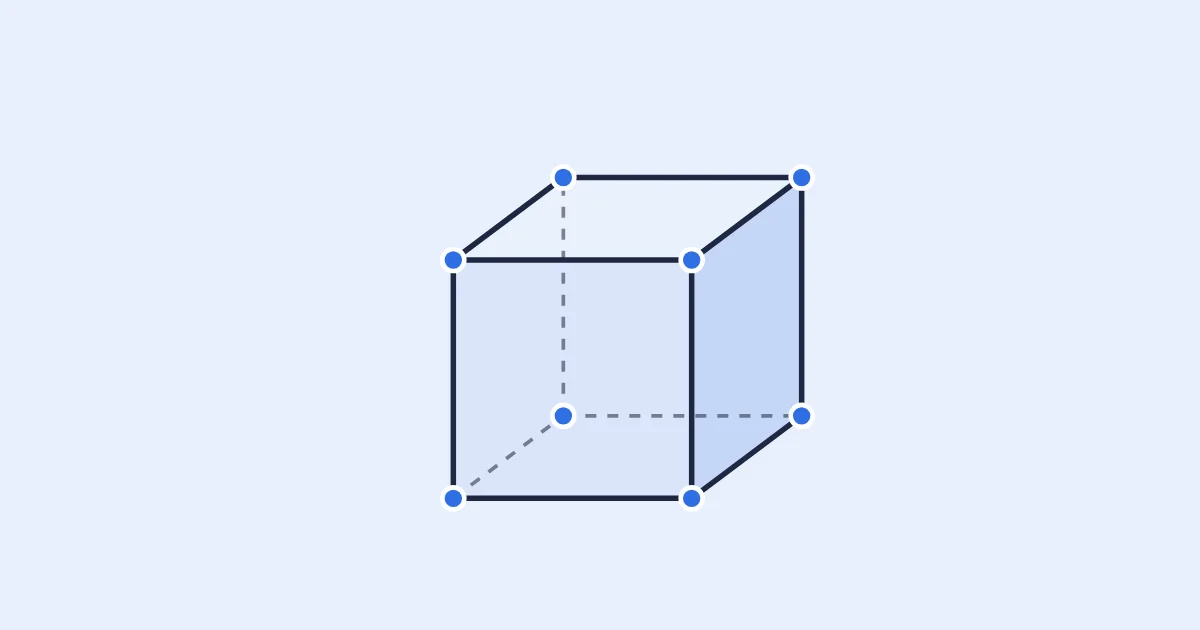
Faces, edges and vertices of 3D shapes
What faces, edges and vertices are, and how many a cube, cuboid, pyramid, prism, cylinder, cone and sphere have. A full table and…
 Geometry
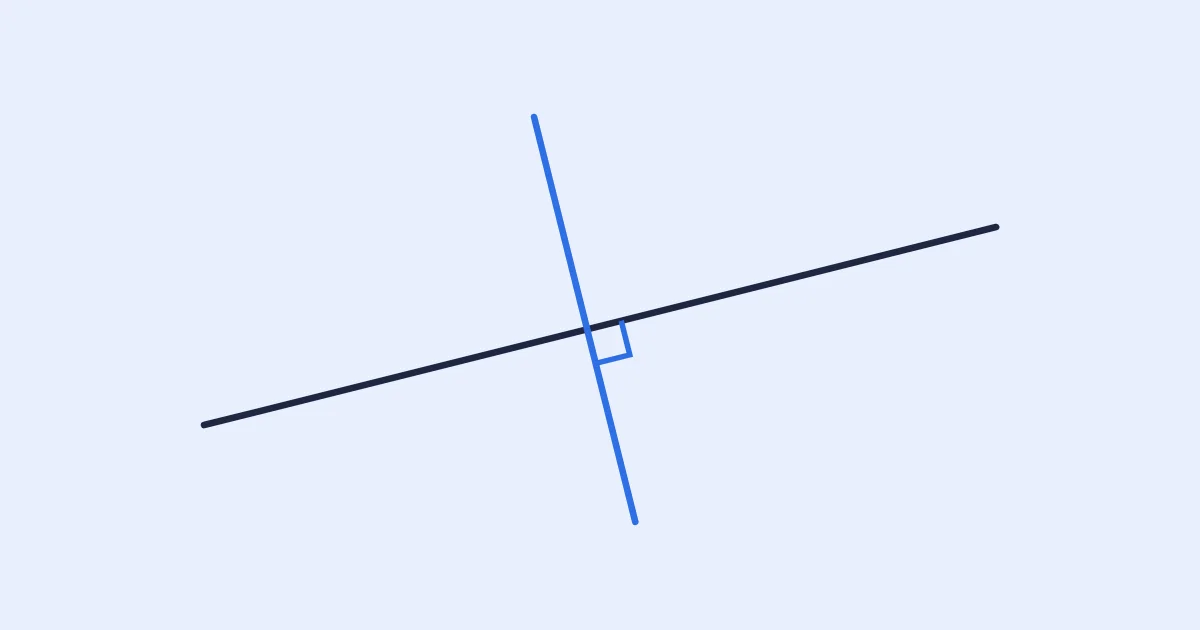
How to draw a perpendicular line
What perpendicular lines are and how to draw one with a set square or a protractor: step by step, through a given point, with tips and…