The three words to know
- Face: a flat surface of the shape. A cube has 6 square faces, like a dice.
- Edge: a straight line where two faces meet. Run your finger along it: it's the "fold".
- Vertex (plural vertices): a point where several edges meet: a corner.
Some 3D shapes also have curved surfaces (cylinders, cones, spheres). In primary school, a curved surface is usually counted separately from the flat faces.
The table to keep handy
| 3D shape | Faces | Edges | Vertices |
|---|---|---|---|
| cube | 6 | 12 | 8 |
| cuboid | 6 | 12 | 8 |
| triangular prism | 5 | 9 | 6 |
| square-based pyramid | 5 | 8 | 5 |
| triangular-based pyramid (tetrahedron) | 4 | 6 | 4 |
| cylinder | 2 flat + 1 curved | 2 curved | 0 |
| cone | 1 flat + 1 curved | 1 curved | 1 (the apex) |
| sphere | 1 curved | 0 | 0 |
How to count without getting lost
Counting edges and vertices on a drawing is hard, because some are hidden. Some tricks:
- Vertices of a cube: 4 on the top face + 4 on the bottom face = 8.
- Edges of a cube: 4 around the top + 4 around the bottom + 4 vertical ones = 12.
- Square-based pyramid: 4 edges around the base + 4 going up to the apex = 8 edges; 4 vertices of the base + the apex = 5 vertices.
- Triangular prism: 3 edges on each triangle + 3 joining them = 9 edges.
With a real object, mark each vertex with a sticker or a dot of pen as you count it.
Cube or cuboid?
Both have 6 faces, 12 edges and 8 vertices. The difference:
- the cube has 6 identical square faces (a dice);
- the cuboid has rectangular faces, in pairs (a cereal box, a brick).
A cube is a special cuboid, just as a square is a special rectangle.
How to explain it to your child
- Handle real objects: dice, cereal boxes, tins (cylinders), Toblerone boxes (triangular prisms), ice-cream cones.
- Build shapes with straws and modelling clay: the straws are the edges and the balls of clay are the vertices.
- Unfold boxes to see all the faces laid flat (see nets of a cube).
- Play "guess the shape": "I have 5 faces and 5 vertices: what am I?".
The most common mistakes
- Forgetting the hidden faces, edges and vertices on a drawing.
- Mixing up edges and vertices.
- Saying "vertexes" or "a vertices": one vertex, two vertices.
- Confusing 2D and 3D shapes: a square is a face of a cube, not a 3D shape.
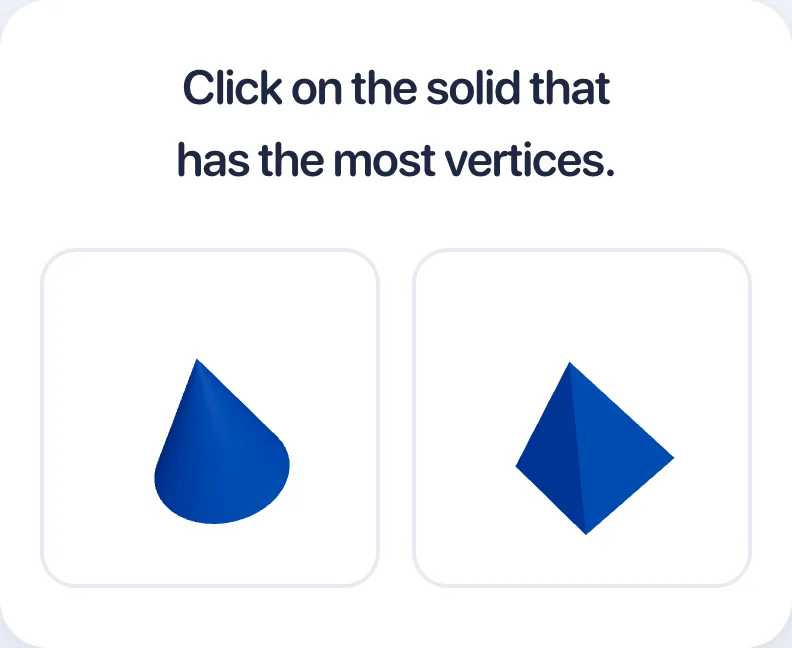
Worked examples
How many vertices does a cuboid have?
How many faces does a triangular prism have?
I have 5 faces, 8 edges and 5 vertices. What am I?
Check Euler's formula for a triangular prism
Frequently asked questions
How many faces, edges and vertices does a cube have?
A cube has 6 faces, 12 edges and 8 vertices.
What's the difference between an edge and a vertex?
An edge is a line where two faces meet; a vertex is a corner, a point where several edges meet.
When do children learn about faces, edges and vertices?
In England, children recognise common 3D shapes in Year 1, describe their faces, edges and vertices in Year 2, and identify 3D shapes from nets in Year 6.
Keep reading: nets of a cube and our lesson 3D shapes.
Find out where your child stands in 20 minutes
The EasyMaths assessment is free: around thirty varied questions covering the whole year’s curriculum, with clear results skill by skill and the exercises to work on next.
Take the free assessment →In the curriculum: Grade 2 (Year 2) · Grade 3 (Year 3) · Grade 4 (Year 4) · Grade 5 (Year 5)
Keep reading
 Geometry
How to draw a perpendicular line
What perpendicular lines are and how to draw one with a set square or a protractor: step by step, through a given point, with tips and…
 Geometry
How to draw parallel lines
What parallel lines are and how to draw them accurately with a ruler and set square: the sliding method step by step, how to check,…
 Geometry
How to use a protractor to measure angles
How to use a protractor: centre on the vertex, zero on one arm, choose the right scale. Types of angles, drawing an angle and the common…