What "parallel" means
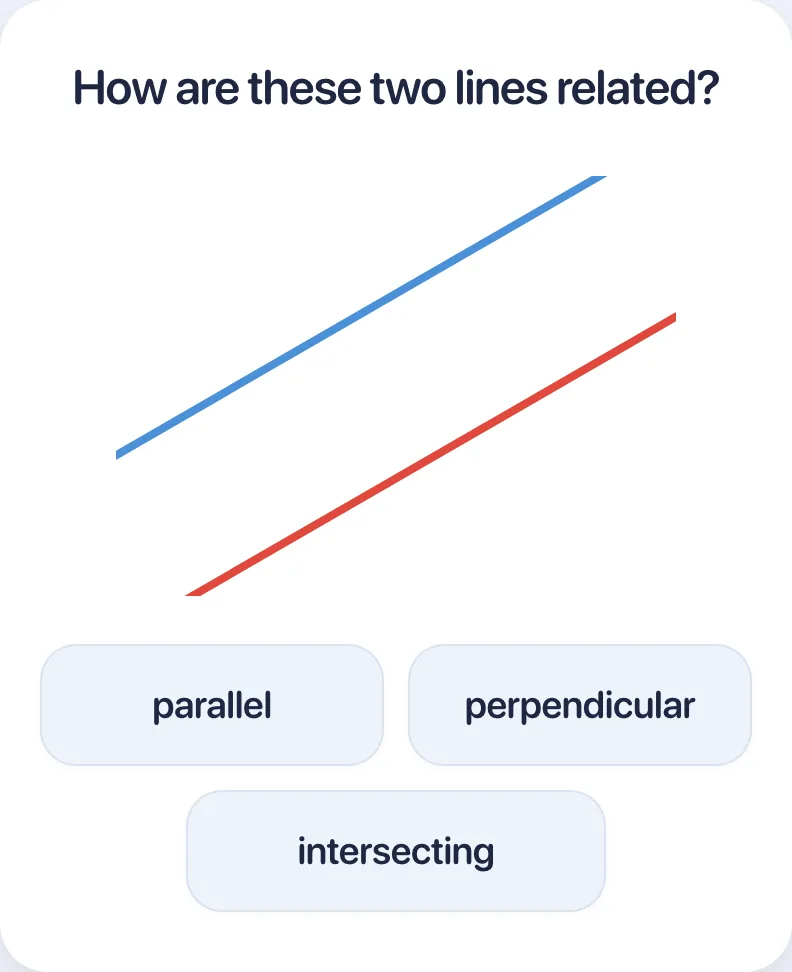
Parallel lines are all around us: the lines on a page, railway tracks, the opposite edges of a table, the strings of a guitar. On diagrams, parallel lines are often marked with small arrows (›) on each line.
Don't confuse:
- parallel: never meeting;
- perpendicular: crossing at a right angle (see how to draw a perpendicular line).
The method: the sliding set square
To draw a line parallel to a line d, through a point A:
- Place one edge of the set square exactly along the line d.
- Place the ruler firmly against another edge of the set square.
- Hold the ruler still with one hand.
- Slide the set square along the ruler until its first edge reaches point A.
- Draw along that edge: the new line is parallel to d.
Another method: two perpendiculars
A line that is perpendicular to a line which is itself perpendicular to d is parallel to d. So:
- Draw a perpendicular to d through point A.
- Draw a perpendicular to that new line, through A.
It's a little longer, but it's a good way to understand the link between parallel and perpendicular.
How to check that two lines are parallel
Measure the distance between them at two different places, at right angles to the lines (with the set square). If it's the same, the lines are parallel.
How to explain it to your child
- Look for parallel lines around the house and in the street: road markings, shelves, stairs.
- Practise on squared paper first, then on plain paper.
- Get them to say each step out loud: "set square on the line, ruler against it, slide, draw".
- Insist on a sharp pencil and a ruler held firmly.
The most common mistakes
- Drawing by eye, without the ruler and set square.
- Moving the ruler while sliding the set square.
- Thinking short lines that don't touch are parallel: they must never meet, even when extended.
- Confusing parallel and perpendicular.
Worked examples
How many pairs of parallel sides does a rectangle have?
Does a triangle have parallel sides?
Two lines are both perpendicular to the same line. What can you say about them?
Frequently asked questions
What are parallel lines?
Lines that never meet, however far they are extended, and always stay the same distance apart: like railway tracks.
How do you draw parallel lines with a set square?
Put the set square along the first line, a ruler against the set square, then slide the set square along the ruler to the new position and draw along its edge.
When do children learn about parallel lines?
In England, children identify parallel and perpendicular lines in Year 3, and use them to classify shapes and draw accurately in Year 4 to Year 6.
Keep reading: how to draw a perpendicular line and our lesson Parallel and perpendicular lines.
Find out where your child stands in 20 minutes
The EasyMaths assessment is free: around thirty varied questions covering the whole year’s curriculum, with clear results skill by skill and the exercises to work on next.
Take the free assessment →In the curriculum: Grade 4 (Year 4) · Grade 5 (Year 5) · Grade 6 (Year 6)
Keep reading
 Geometry
How to use a protractor to measure angles
How to use a protractor: centre on the vertex, zero on one arm, choose the right scale. Types of angles, drawing an angle and the common…
 Geometry
How to work out the perimeter of a rectangle
How to work out perimeter: add up the sides, or (length + width) × 2 for a rectangle. Squares, missing sides, perimeter vs area, worked…
 Geometry
Lines of symmetry: how to find them
How to find lines of symmetry: the folding and mirror tests, how many lines squares, rectangles, triangles and circles have, and…