First: the types of angles
Before measuring, your child should be able to estimate. Four types of angles to recognise:
| Angle | Size |
|---|---|
| acute | less than 90° |
| right angle | exactly 90° (a square corner) |
| obtuse | between 90° and 180° |
| straight line | 180° |
| reflex | more than 180° |
Measuring an angle, step by step
- Place the centre of the protractor exactly on the vertex (the point where the two arms meet).
- Line up the zero line (the straight bottom edge, or the line through the centre) with one arm of the angle.
- Find the scale that starts at 0 on that arm. A protractor has two scales (inner and outer) running in opposite directions: use the one where your arm points at 0, not 180.
- Follow that scale until you reach the other arm, and read the number.
- Check with your estimate: if the angle is clearly acute, the answer must be less than 90°.
The big trap: the two scales
Every protractor has two rows of numbers. For a 60° angle, the other arm also points at 120° on the other scale. Which one is right?
- If the angle is acute (smaller than a right angle), it's the smaller number: 60°.
- If it's obtuse, it's the bigger number.
That's why estimating first is so important: it tells you straight away which scale to use.
If the arms are too short
If an arm doesn't reach the scale, extend it with a ruler (lightly, in pencil) before measuring. It doesn't change the angle: the size of an angle depends on how far it opens, not on the length of its arms.
Drawing an angle (for example 50°)
- Draw a straight line with a ruler: that's the first arm. Mark the vertex at one end.
- Put the centre of the protractor on the vertex, zero line along the arm.
- On the scale that starts at 0, find 50 and make a small mark.
- Remove the protractor and join the vertex to the mark with a ruler.
- Label the angle: 50°.
Reflex angles (more than 180°)
A standard protractor only goes up to 180°. To measure a reflex angle, measure the smaller angle on the other side and subtract it from 360°. If the small angle is 110°, the reflex angle is 360° − 110° = 250°.
How to explain it to your child
- Find angles around the house: the corner of a book (right angle), an open door, the hands of a clock.
- Always estimate first: "Is it acute or obtuse? About how many degrees?".
- Use a clear plastic protractor, so the lines show through.
- Practise both directions: angles opening to the left and to the right.
The most common mistakes
- Centre not on the vertex: the measurement is then wrong.
- Reading the wrong scale (120° instead of 60°).
- Not lining up zero with an arm, so the reading is off by a few degrees.
- Thinking longer arms mean a bigger angle.
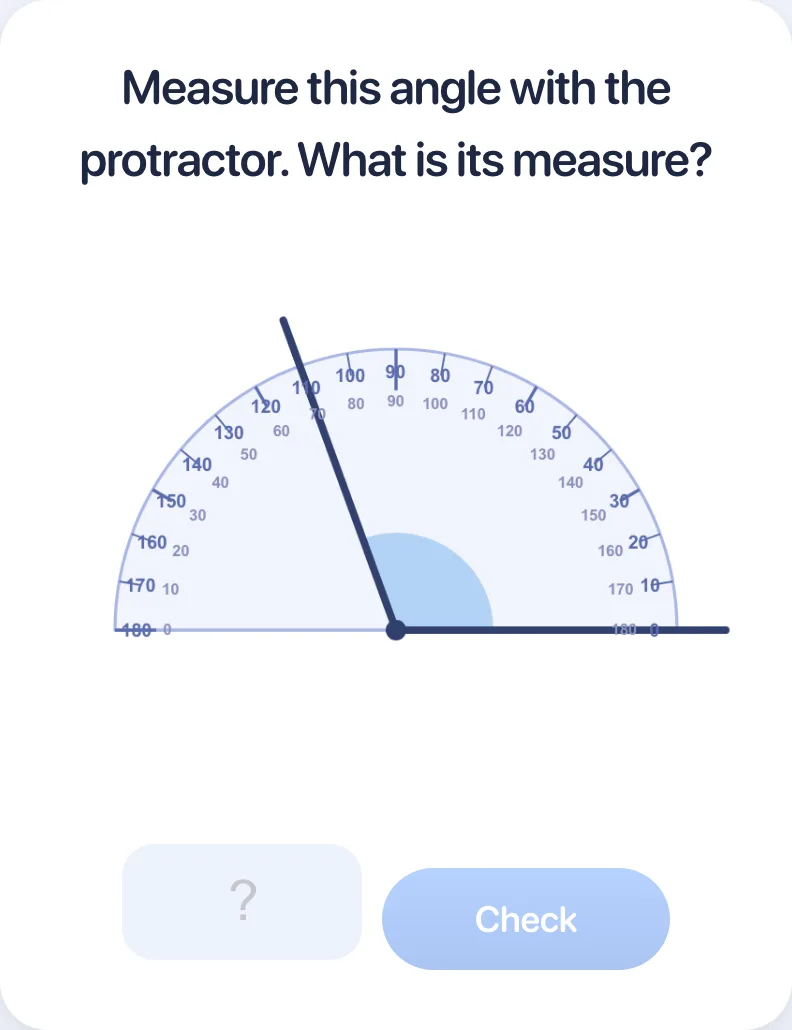
Worked examples
Is a 135° angle acute or obtuse?
An arm points at 40 on one scale and 140 on the other. The angle is acute. What is it?
What is the angle between the hands of a clock at 3 o'clock?
The small angle is 70°. What is the reflex angle?
Frequently asked questions
Which scale do you use on a protractor?
The one that starts at 0 on the arm lined up with the zero line. To be sure, estimate first: an acute angle is less than 90°, an obtuse angle is more.
How do you measure an angle bigger than 180°?
Measure the smaller angle on the other side, then subtract it from 360°.
When do children learn to use a protractor?
In England, children identify acute and obtuse angles in Year 4, and measure and draw angles in degrees with a protractor in Year 5 and Year 6.
Keep reading: types of triangles and our lesson Angles.
Find out where your child stands in 20 minutes
The EasyMaths assessment is free: around thirty varied questions covering the whole year’s curriculum, with clear results skill by skill and the exercises to work on next.
Take the free assessment →In the curriculum: Grade 4 (Year 4) · Grade 5 (Year 5) · Grade 6 (Year 6)
Keep reading
 Geometry
How to work out the perimeter of a rectangle
How to work out perimeter: add up the sides, or (length + width) × 2 for a rectangle. Squares, missing sides, perimeter vs area, worked…
 Geometry
Lines of symmetry: how to find them
How to find lines of symmetry: the folding and mirror tests, how many lines squares, rectangles, triangles and circles have, and…
 Geometry
Nets of a cube: the 11 nets and how to spot them
What a net of a cube is, the 11 different nets, how to tell whether a shape of 6 squares folds into a cube, and which ones don't work.