What is a net?
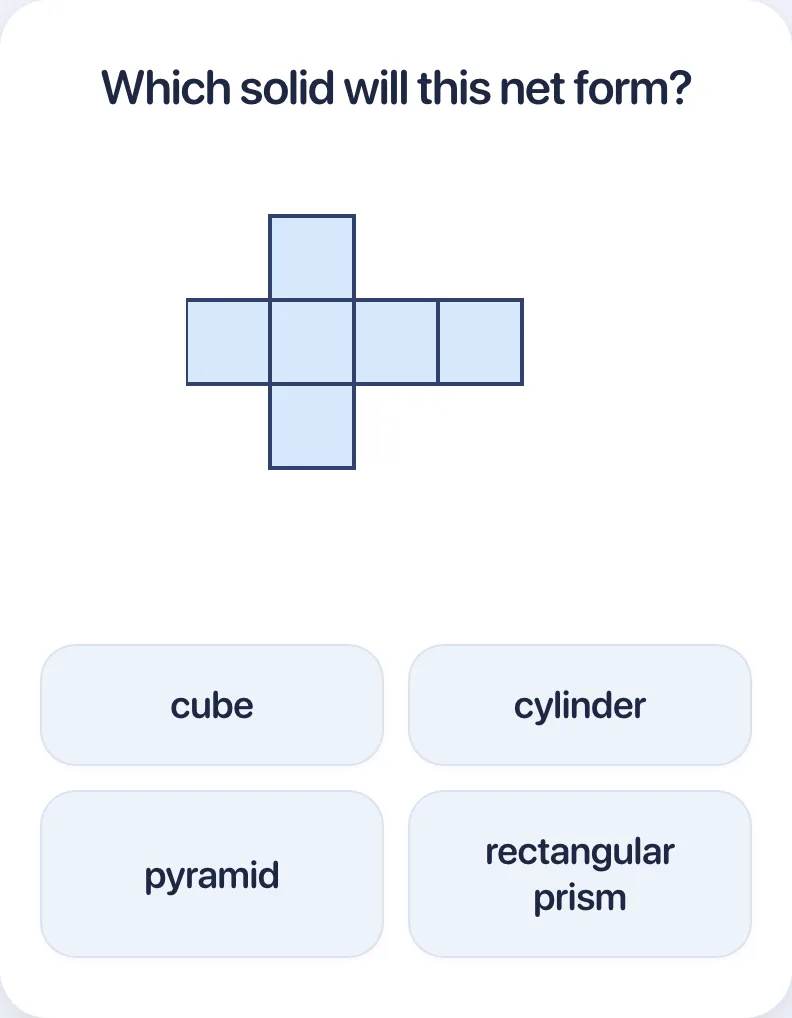
Take a cereal box (a cuboid) and carefully unstick it so it lies flat: what you get is the net of the box. For a cube, the net is made of 6 squares: a top, a bottom and four sides.
Nets are what packaging designers use, and what children cut out at school to make dice.
Some nets that work
The best-known one is the cross above. Here are others:
In total, there are 11 different nets (not counting rotations and reflections of the same net).
How to tell whether a net works
Some tips to check without cutting:
- There must be exactly 6 squares.
- A row of 4 squares in a line: the squares above and below the row must be on opposite sides (one above, one below): two on the same side would overlap.
- Never 5 squares in a row: the 5th would land on top of the 1st.
- No 2 × 2 block of squares: four squares in a square can't fold into a cube.
- Imagine folding: pick one square as the base, fold the others up around it, and check that each square becomes a different face.
A net that doesn't work
It contains a 2 × 2 block of squares, and that can never fold into a cube: take the middle-bottom square as the base and fold the others up: the two top corner squares land on the side faces, and there's nothing left for the lid.
How to practise at home
- Draw nets on squared paper, cut them out and fold them: the best way to build visual imagination.
- Unfold packaging (boxes of tea, toothpaste, cereal) to see their nets.
- Make a dice: draw a net, number the faces so opposite faces add up to 7, fold and test it.
- Find all 11: a lovely challenge for a rainy afternoon.
The most common mistakes
- Thinking any 6 squares make a cube.
- Forgetting to imagine the folding and just counting squares.
- Putting two squares on the same side of a row of 4.
- Counting the same net twice when it's just rotated or flipped.
Worked examples
How many squares are in a net of a cube?
Can a net of a cube have 5 squares in a row?
In the cross net, which square is opposite the top one?
How many different nets does a cube have?
Frequently asked questions
How many nets of a cube are there?
There are exactly 11 different nets of a cube, not counting rotations and reflections.
How do you know if a net makes a cube?
It must have 6 squares joined by their edges, with no 2 × 2 block and no row of 5. Imagine folding it: each square must become a different face, with no overlaps.
When do children learn about nets?
In England, children recognise and build 3D shapes, including making them from nets, in Year 5 and Year 6.
Keep reading: faces, edges and vertices and our lesson 3D shapes.
Find out where your child stands in 20 minutes
The EasyMaths assessment is free: around thirty varied questions covering the whole year’s curriculum, with clear results skill by skill and the exercises to work on next.
Take the free assessment →In the curriculum: Grade 4 (Year 4) · Grade 5 (Year 5) · Grade 6 (Year 6)
Keep reading
 Geometry
Types of triangles: equilateral, isosceles, scalene
Types of triangles explained for children: equilateral, isosceles, scalene and right-angled. Recognising them by sides and angles, the…
 Geometry
How to find the area of a rectangle
How to find the area of a rectangle: length × width, in cm² or m². Why the formula works, area vs perimeter, diagrams and worked examples.
 Geometry
Faces, edges and vertices of 3D shapes
What faces, edges and vertices are, and how many a cube, cuboid, pyramid, prism, cylinder, cone and sphere have. A full table and…