Perimeter is the distance around
Imagine an ant walking all the way around a rectangle along its edges: the distance it walks is the perimeter. Or think of the length of fence you'd need to go round a garden.
Why (L + W) × 2?
A rectangle has two equal lengths and two equal widths. Going all the way round means walking a length, a width, a length and a width:
6 + 4 + 6 + 4 = 20
You can group them: (6 + 4) + (6 + 4) = 10 + 10 = 20. Hence the formula (L + W) × 2. You can also work out L × 2 + W × 2 = 12 + 8 = 20.
The perimeter of a square
A square has four equal sides, so its perimeter is side × 4. A square with 5 cm sides has a perimeter of 5 × 4 = 20 cm.
Watch the units
The lengths must be in the same unit before adding. A rectangle 2 m by 50 cm:
- convert: 2 m = 200 cm;
- P = (200 + 50) × 2 = 500 cm, or 5 m.
Finding a missing side from the perimeter
A rectangle has a perimeter of 30 cm and a length of 9 cm. What is its width?
- Half the perimeter is 30 ÷ 2 = 15 cm (that's L + W).
- The width is 15 − 9 = 6 cm.
Check: (9 + 6) × 2 = 30. ✔
Perimeter or area?
| Perimeter | Area | |
|---|---|---|
| What it is | the distance around | the surface inside |
| Rectangle 6 × 4 | (6 + 4) × 2 = 20 cm | 6 × 4 = 24 cm² |
| Units | cm, m | cm², m² |
See also how to find the area of a rectangle.
How to explain it to your child
- Get them to trace round the shape with a finger (or a piece of string) before calculating.
- Measure real things: around the table, their bedroom, a picture frame.
- Get them to write all four sides as a sum at first, before using the formula.
- Compare with area on the same rectangle to separate the two ideas clearly.
The most common mistakes
- Adding only two sides: 6 + 4 = 10 (that's only half the perimeter).
- Multiplying instead of adding: 6 × 4 = 24 (that's the area).
- Forgetting the brackets: 6 + 4 × 2 = 14 (wrong: the sum must be worked out first).
- Mixing units (m and cm).
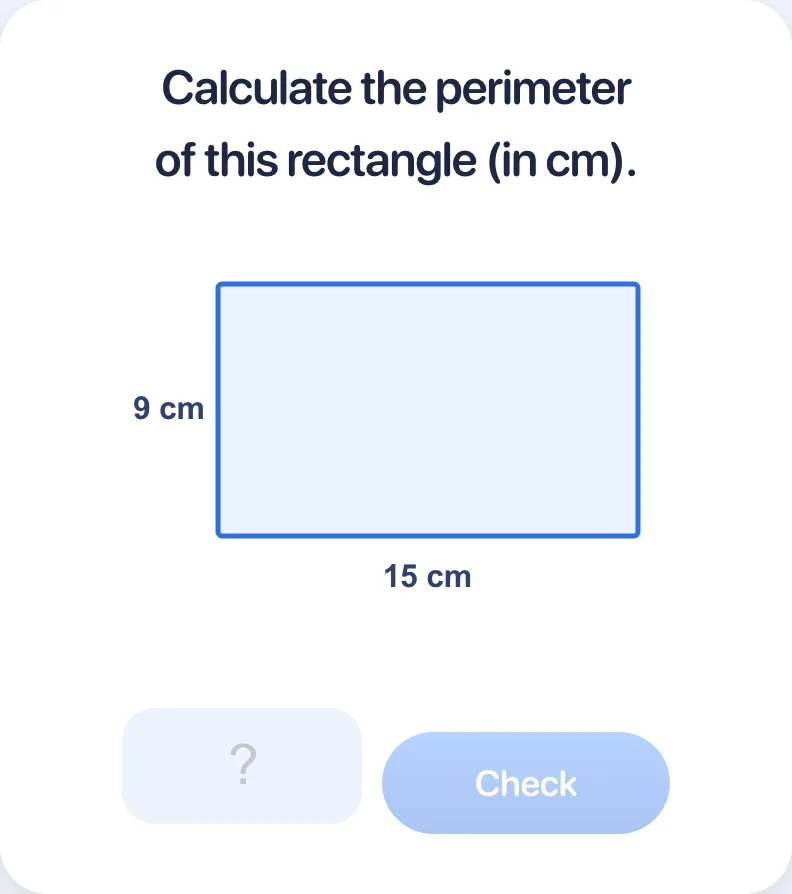
Worked examples
Perimeter of a rectangle 8 cm by 3 cm
Perimeter of a square with 7 m sides
Perimeter of a rectangle 1.5 m by 80 cm, in cm
A square has a perimeter of 36 cm. How long is each side?
A rectangle has a perimeter of 24 cm and a width of 4 cm. What is its length?
Frequently asked questions
What is the formula for the perimeter of a rectangle?
P = (length + width) × 2. For a rectangle 6 cm by 4 cm: (6 + 4) × 2 = 20 cm.
How do you work out the perimeter of a square?
Multiply the length of one side by 4, because all four sides are equal: a square with 5 cm sides has a perimeter of 20 cm.
When do children learn about perimeter?
In England, children measure the perimeter of simple shapes in Year 3, work out the perimeter of rectangles in Year 4, and solve perimeter problems in Year 5 and Year 6.
Keep reading: our lesson Perimeter and area.
Find out where your child stands in 20 minutes
The EasyMaths assessment is free: around thirty varied questions covering the whole year’s curriculum, with clear results skill by skill and the exercises to work on next.
Take the free assessment →In the curriculum: Grade 3 (Year 3) · Grade 4 (Year 4) · Grade 5 (Year 5)
Keep reading
 Geometry
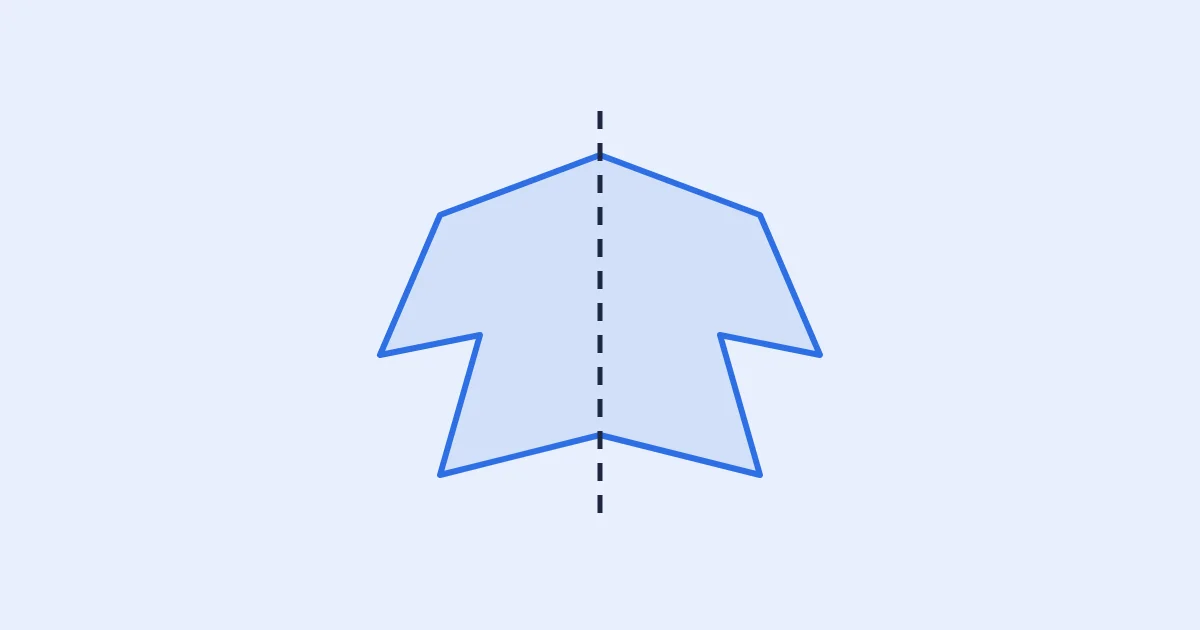
Lines of symmetry: how to find them
How to find lines of symmetry: the folding and mirror tests, how many lines squares, rectangles, triangles and circles have, and…
 Geometry
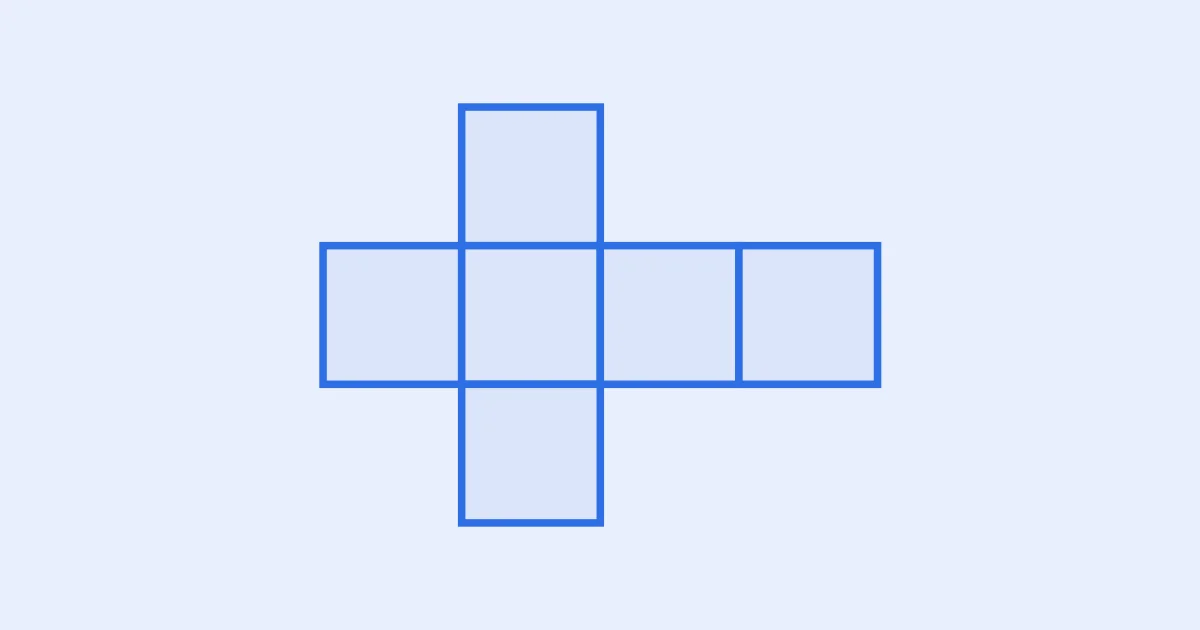
Nets of a cube: the 11 nets and how to spot them
What a net of a cube is, the 11 different nets, how to tell whether a shape of 6 squares folds into a cube, and which ones don't work.
 Geometry
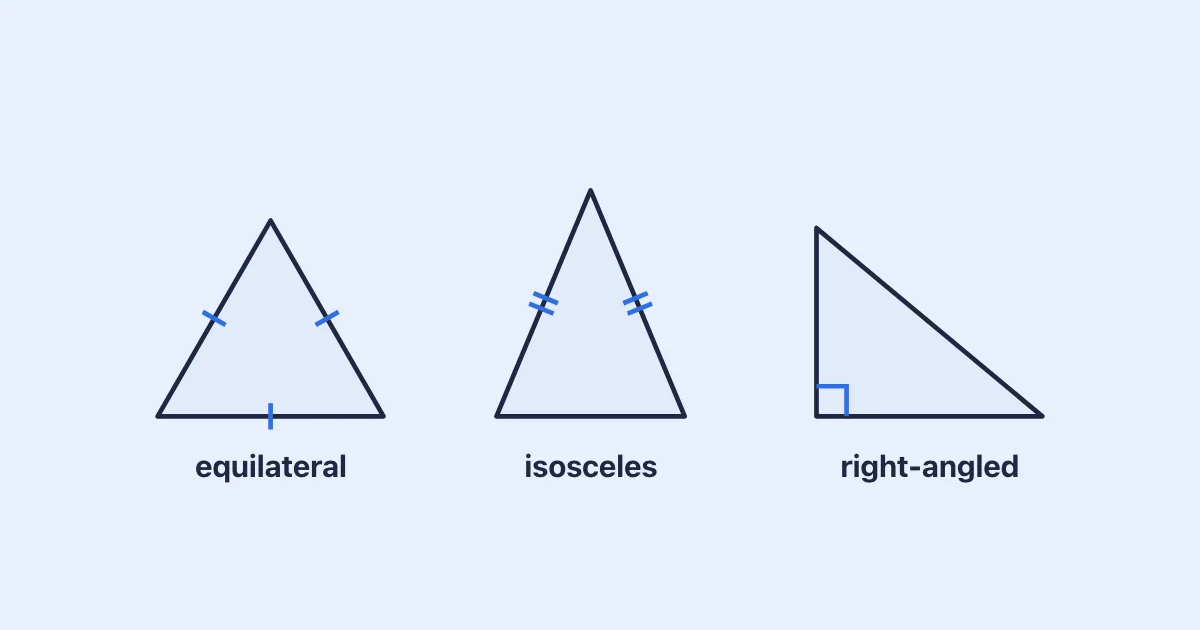
Types of triangles: equilateral, isosceles, scalene
Types of triangles explained for children: equilateral, isosceles, scalene and right-angled. Recognising them by sides and angles, the…