Before you start
Your child needs to be comfortable with the bus stop method for whole numbers. If not, start with our article the bus stop method.
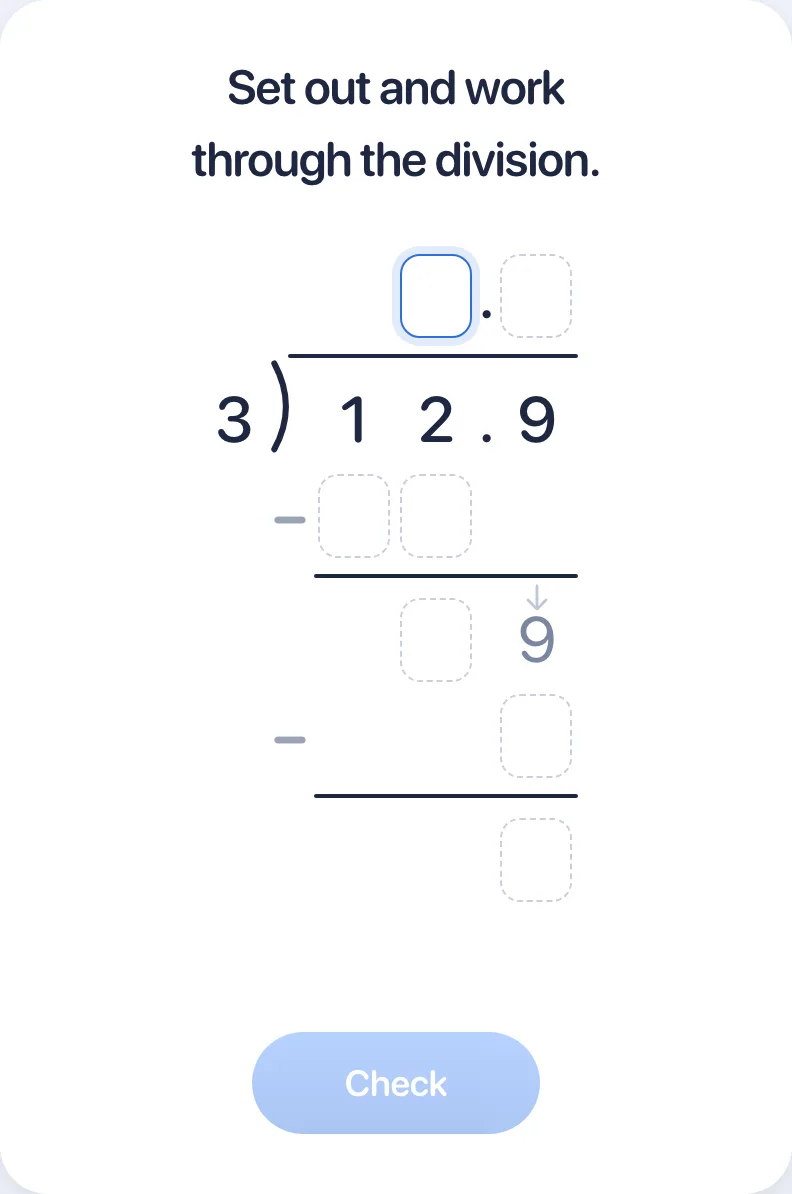
Example 1: 8.4 ÷ 3
- Whole number part: 8 ÷ 3 = 2, remainder 2 (3 × 2 = 6, and 8 − 6 = 2). Write 2 on top.
- The decimal point: write it in the answer, directly above the point in 8.4.
- Carry the 2 in front of the 4 → 24. 24 ÷ 3 = 8. Write 8 on top.
Answer: 8.4 ÷ 3 = 2.8. Check: 2.8 × 3 = 8.4. ✔
Example 2: 15.6 ÷ 4
- 15 ÷ 4 = 3, remainder 3.
- Decimal point in the answer, above the point.
- Carry 3 → 36. 36 ÷ 4 = 9.
Answer: 15.6 ÷ 4 = 3.9.
When the divisor is bigger than the whole number part
Example: 2.5 ÷ 5. 5 doesn't go into 2: write 0 on top, then the decimal point, then carry the 2 → 25 ÷ 5 = 5. Answer: 0.5.
When there's a remainder: carry on with zeros
A number can always be written with zeros on the end: 7 = 7.0 = 7.00. So you can keep dividing beyond the last digit.
Example: 7 ÷ 4.
- 7 ÷ 4 = 1, remainder 3. Write the decimal point (7 = 7.0).
- Carry the 3 in front of a 0 → 30. 30 ÷ 4 = 7, remainder 2.
- Add another 0 → 20. 20 ÷ 4 = 5, remainder 0.
Answer: 7 ÷ 4 = 1.75.
Some divisions never end: 10 ÷ 3 = 3.333… You then stop at the place you need (tenths, hundredths) and round. See how to round decimals.
How to explain it to your child
- Start with sharing money: £8.40 shared between 3 children → £2.80 each.
- Get them to put a dot on top first, directly above the decimal point, before dividing.
- Always check with multiplication: answer × divisor = number divided.
- Estimate: 15.6 ÷ 4 is about 16 ÷ 4 = 4.
The most common mistakes
- Forgetting the decimal point in the answer (8.4 ÷ 3 = 28).
- Putting the point in the wrong place.
- Forgetting the 0 before the point (2.5 ÷ 5 = .5).
- Stopping with a remainder when you could carry on with zeros.
Worked examples
9.6 ÷ 3
12.5 ÷ 5
3.6 ÷ 4
9 ÷ 4
17.5 ÷ 7
Frequently asked questions
Where does the decimal point go when dividing a decimal?
Directly above the decimal point in the number being divided. In the bus stop method, put it in the answer before you divide the digits after the point.
How do you carry on a division that has a remainder?
Add a zero on the end of the number being divided (7 = 7.0 = 7.00), carry the remainder in front of it and keep dividing. If the number was whole, put the decimal point in the answer when you use the first zero.
When do children learn to divide decimals?
In England, children divide numbers with up to two decimal places by whole numbers in Year 6, and use division to give answers as decimals.
Keep reading: our lessons Long division and Calculating with decimals.
Find out where your child stands in 20 minutes
The EasyMaths assessment is free: around thirty varied questions covering the whole year’s curriculum, with clear results skill by skill and the exercises to work on next.
Take the free assessment →In the curriculum: Grade 5 (Year 5) · Grade 6 (Year 6)
Keep reading
 Decimals
How to compare decimals
How to compare two decimals: whole number part first, then tenths, hundredths… The 2.15 vs 2.9 trap, the 'add a zero' trick, diagrams…
 Decimals
How to round decimals
How to round decimals to the nearest whole number, tenth or hundredth: the 'look at the next digit' rule, the number line, the tricky…
 Decimals
Multiplying decimals: where does the point go?
How to multiply decimals: multiply without the decimal points, then count the decimal places to place the point. Step by step, with checks.