First: does your child understand what dividing means?
Before any method, children need to know what dividing means. Two situations, with real objects:
- Sharing: "12 sweets shared between 3 children: how many each?" → hand them out one at a time: 4 each.
- Grouping: "12 sweets in bags of 3: how many bags?" → make groups: 4 bags.
Both are written 12 ÷ 3 = 4. Point out the link with multiplication: 3 × 4 = 12. Dividing is finding the missing number in a multiplication.
What to check first
The bus stop method relies on three skills. If one is missing, work on that first:
- Times tables. This is the big one: to work out "how many 6s in 37", you need the 6 times table. (See our guide how to learn times tables.)
- Remainders: knowing that 37 ÷ 6 is 6 remainder 1.
- Place value: in 684, the 6 is worth 6 hundreds.
The vocabulary
| Word | What it is | In 157 ÷ 6 |
|---|---|---|
| Dividend | the number being divided | 157 |
| Divisor | the number you divide by | 6 |
| Quotient | the answer | 26 |
| Remainder | what's left over | 1 |
And the sentence that lets you check everything: divisor × quotient + remainder = dividend. Here: 6 × 26 + 1 = 157. ✔
Example 1: 684 ÷ 4
Set it out with 684 inside the bus stop, 4 outside on the left, and the answer on top.
- 6 ÷ 4: 4 goes into 6 once, remainder 2. Write 1 on top, and carry the 2 as a small digit in front of the 8 → 28.
- 28 ÷ 4 = 7, no remainder. Write 7 on top.
- 4 ÷ 4 = 1. Write 1 on top.
Answer: 684 ÷ 4 = 171. Check: 4 × 171 = 684. ✔
Example 2: 157 ÷ 6 (with a remainder)
- 1 ÷ 6: 6 doesn't go into 1, so write 0 on top (or leave it blank) and carry the 1 → 15.
- 15 ÷ 6: 2 times (6 × 2 = 12), remainder 3. Write 2 on top and carry 3 → 37.
- 37 ÷ 6: 6 times (6 × 6 = 36), remainder 1. Write 6 on top.
- No digits left: the remainder is 1.
Answer: 157 ÷ 6 = 26 r 1. Check: 6 × 26 + 1 = 157. ✔
The 5 most common mistakes
- Forgetting to carry the remainder to the next digit.
- Missing a zero in the answer. In 612 ÷ 6: 6 ÷ 6 = 1, then 1 ÷ 6 doesn't go: you must write 0 on top before carrying. Answer: 102, not 12.
- A remainder bigger than the divisor: a sign of a times table slip.
- Starting from the right, as in addition. Division always starts from the left.
- Not checking. Divisor × quotient + remainder takes 30 seconds and catches almost every mistake.
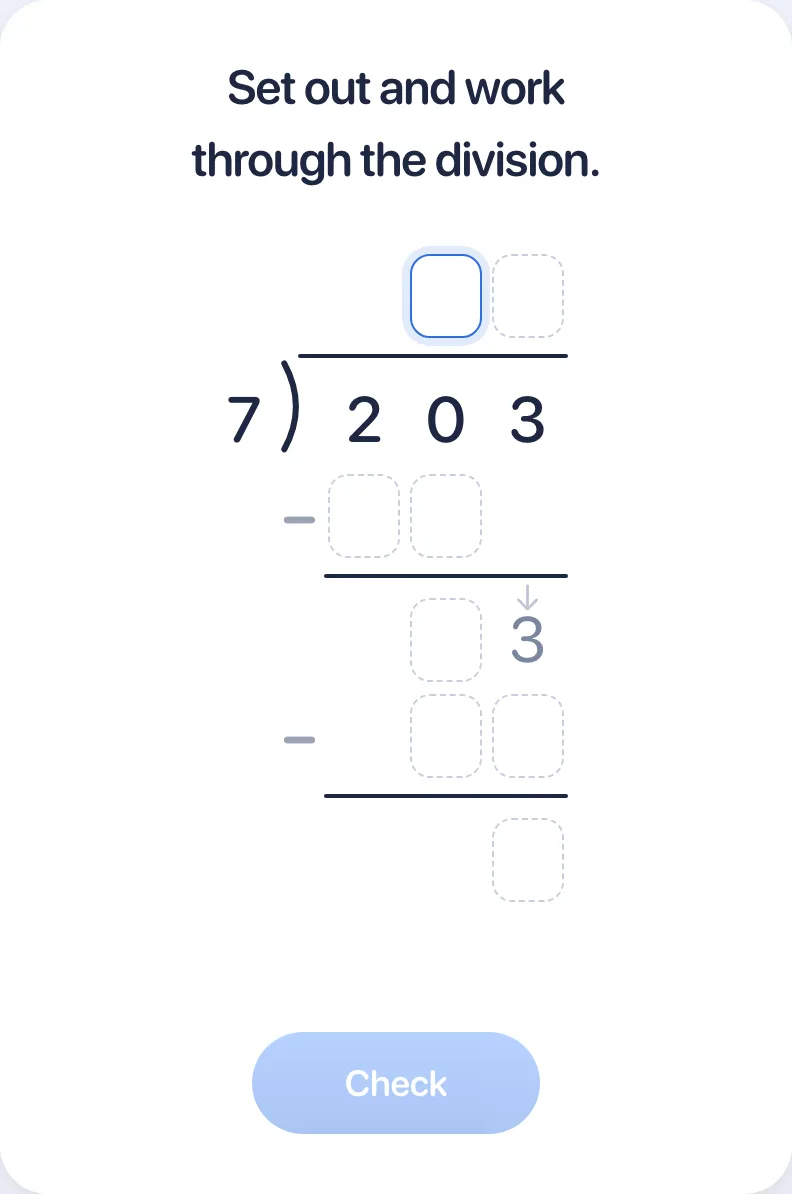
Short division or long division?
- Short division (the bus stop method) is used for dividing by a single digit, usually from Year 4 and Year 5.
- Long division is used in Year 6 for dividing by two-digit numbers (like 432 ÷ 12). It uses the same bus stop layout, but you write each subtraction underneath instead of carrying small digits. The steps are the same: divide, multiply, subtract, bring down.
Did you know? Division is set out differently around the world
If you learned division in another country, don't be surprised if it looks different: the calculation is the same, but the layout changes.
- In the UK, the US and Canada, the answer goes on top, above the bracket: the bus stop.
- In France, Spain or Morocco, the divisor and answer go in a box to the right of the number (the "potence").
- In Germany, it's written on one line: 684 : 4 = 171, with the working underneath.
What matters most for your child is using the same layout as their school. In EasyMaths, written divisions automatically appear in the style of your country.
Practising without frustration
- One or two divisions a day, not a whole page.
- Start with divisions that have no remainder, then introduce remainders.
- Talk through the steps out loud: "how many 4s in 6? One, remainder 2, carry the 2…".
- Practise with instant feedback, so mistakes are spotted straight away.
In a nutshell
- Check that sharing and grouping and times tables are secure.
- Learn the vocabulary: dividend, divisor, quotient, remainder.
- Work from left to right: divide, write on top, carry the remainder.
- Always check: divisor × quotient + remainder = dividend.
Keep reading: our lessons Long division and Division facts.
Find out where your child stands in 20 minutes
The EasyMaths assessment is free: around thirty varied questions covering the whole year’s curriculum, with clear results skill by skill and the exercises to work on next.
Take the free assessment →In the curriculum: Grade 3 (Year 3) · Grade 4 (Year 4) · Grade 5 (Year 5)
Keep reading
 Written methods
Column subtraction with exchanging, explained
How to do column subtraction with exchanging (also called borrowing or regrouping): a step-by-step method, the tricky zero case and…
 Written methods
How to do long multiplication
How to do long multiplication (2-digit by 2-digit): two rows, the placeholder zero, carrying and the final addition. With a checking…
 Decimals
Dividing decimals by whole numbers
How to divide a decimal by a whole number with the bus stop method: the decimal point goes above the point, then carry on with zeros.…