Step 1: compare the whole number part
This is the easy bit: the number with the bigger whole number part is bigger, whatever comes after the decimal point.
- 5.1 > 4.99: 5 ones is more than 4 ones, even with 99 hundredths.
- 12.3 > 9.876: 12 > 9.
Step 2: if the whole numbers match, compare digit by digit
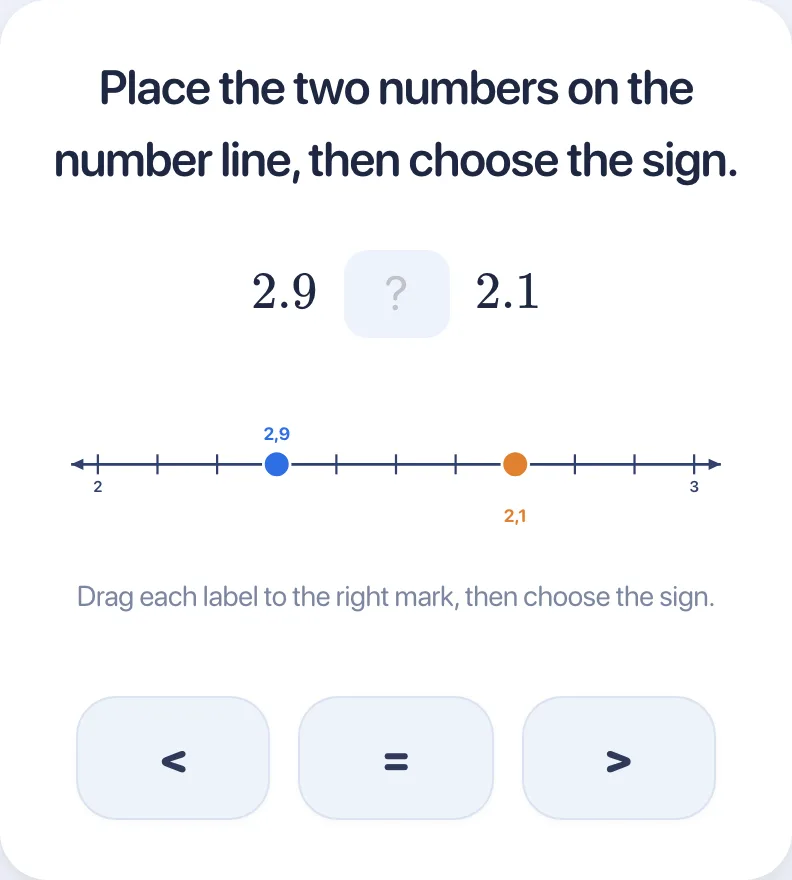
Compare 2.15 and 2.9. The whole number parts are equal (2). Look at the tenths: 1 for 2.15 and 9 for 2.9. Since 9 > 1, 2.9 > 2.15. No need to go further.
A place value chart makes it obvious:
| ones | tenths | hundredths |
|---|---|---|
| 2. | 1 | 5 |
| 2. | 9 | 0 |
And on a number line, 2.9 is much further to the right:
The big trap: "15 is more than 9"
Many children (and not only children!) think that 2.15 > 2.9 because "15 is bigger than 9". It's the most common mistake with decimals. The reason: the 1 in 2.15 is worth 1 tenth and the 5 is worth 5 hundredths, whereas the 9 in 2.9 is worth 9 tenths.
With money, it all makes sense
Money is the best way to understand decimals:
- £2.90 is 2 pounds and 90 pence.
- £2.15 is 2 pounds and 15 pence.
Nobody hesitates: £2.90 is more than £2.15. Make this link with your child as often as you can.
Ordering several decimals
To put 3.5, 3.25, 3.05 and 3.52 in ascending order:
- Write all the numbers with the same number of decimal places: 3.50, 3.25, 3.05, 3.52.
- Same whole number (3), so compare the decimal parts: 50, 25, 05, 52.
- Answer: 3.05 < 3.25 < 3.5 < 3.52.
How to explain it to your child
- Use money (pounds and pence) for all the first examples.
- Get them to write the numbers in a place value chart (ones, tenths, hundredths) before comparing.
- Make adding zeros a habit at first: 4.7 → 4.70.
- Read the numbers properly: "2 ones and 9 tenths" rather than "two point nine" helps them see the value of each digit.
The most common mistakes
- Comparing the decimal parts like whole numbers: 2.15 > 2.9 (wrong).
- Thinking the longer number is bigger: 3.125 > 3.5 (wrong).
- Thinking that adding a zero changes the value: 2.9 and 2.90 are equal.
- Forgetting to look at the whole number part first: 4.99 < 5.1.
Worked examples
Compare 7.8 and 7.45
Compare 0.6 and 0.58
Compare 12.3 and 12.30
Ascending order: 1.4, 1.04, 1.44, 1.14
Frequently asked questions
Why is 2.9 bigger than 2.15?
Because you compare place by place: the ones are equal (2), but 2.9 has 9 tenths while 2.15 has only 1. Writing 2.9 as 2.90 shows you're comparing 90 hundredths with 15 hundredths.
Can you add zeros after the decimal point?
Yes, at the end of the decimal part: 2.9 = 2.90 = 2.900. The value doesn't change. But you can't add one straight after the point: 2.9 is not the same as 2.09.
When do children learn to compare decimals?
In England, decimals are introduced in Year 4, where children compare numbers with up to two decimal places. They compare and order numbers with three decimal places in Year 5.
Keep reading: our lesson Decimal numbers and how to round decimals.
Find out where your child stands in 20 minutes
The EasyMaths assessment is free: around thirty varied questions covering the whole year’s curriculum, with clear results skill by skill and the exercises to work on next.
Take the free assessment →In the curriculum: Grade 4 (Year 4) · Grade 5 (Year 5) · Grade 6 (Year 6)
Keep reading
 Decimals
How to round decimals
How to round decimals to the nearest whole number, tenth or hundredth: the 'look at the next digit' rule, the number line, the tricky…
 Decimals
Multiplying decimals: where does the point go?
How to multiply decimals: multiply without the decimal points, then count the decimal places to place the point. Step by step, with checks.
 Decimals
Adding and subtracting decimals
How to add and subtract decimals: line up the decimal points, fill gaps with zeros, use the column method and place the point in the…