Why line up the decimal points?
In any addition, you always add things of the same value: ones with ones, tenths with tenths. Lining up the decimal points makes sure every digit is in the right column.
With money, it's obvious: to add £12.50 and £3.75, you add the pounds together and the pence together.
The method, step by step: 12.5 + 3.75
- Write the numbers with the decimal points lined up. 12.5 has only one decimal place, so write it as 12.50.
- Add from right to left, starting with the hundredths:
- hundredths: 0 + 5 = 5;
- tenths: 5 + 7 = 12: write 2, carry 1;
- ones: 2 + 3 + 1 (carried) = 6;
- tens: 1.
- Bring the decimal point down in line with the others.
Answer: 12.5 + 3.75 = 16.25.
Subtracting decimals
It's exactly the same method: line up the decimal points, fill gaps with zeros, then subtract as usual (exchanging where needed).
Example: 8 − 2.45. Write 8.00 − 2.45:
- hundredths: 0 − 5 isn't possible, so exchange: 10 − 5 = 5;
- tenths: after exchanging, 9 − 4 = 5;
- ones: 7 − 2 = 5.
Answer: 8 − 2.45 = 5.55. Check: 5.55 + 2.45 = 8. ✔
The zeros you add here are essential: without them, your child wouldn't know what to do with the 4 and the 5. For the exchanging technique, see column subtraction with exchanging.
Check with an estimate
12.5 + 3.75 is about 13 + 4 = 17. Our answer, 16.25, makes sense. If your child got 4.999 or 125.75, the estimate would point to a lining-up mistake.
How to explain it to your child
- Start with money: adding prices (£2.50 + £1.20), with real coins at first.
- Use squared paper: one digit per square, the decimal point on a line.
- Insist on the extra zeros at first, until lining up becomes automatic.
- Always estimate before calculating.
The most common mistakes
- Lining the numbers up on the right like whole numbers: putting the 5 of 12.5 under the 5 of 3.75 gives the wrong answer.
- Forgetting the decimal point in the answer (1625 instead of 16.25).
- Adding the whole parts and decimal parts separately: 12.5 + 3.75 → 15 and 5 + 75 = 80 → 15.80 (wrong).
- Forgetting the carry from the tenths to the ones.
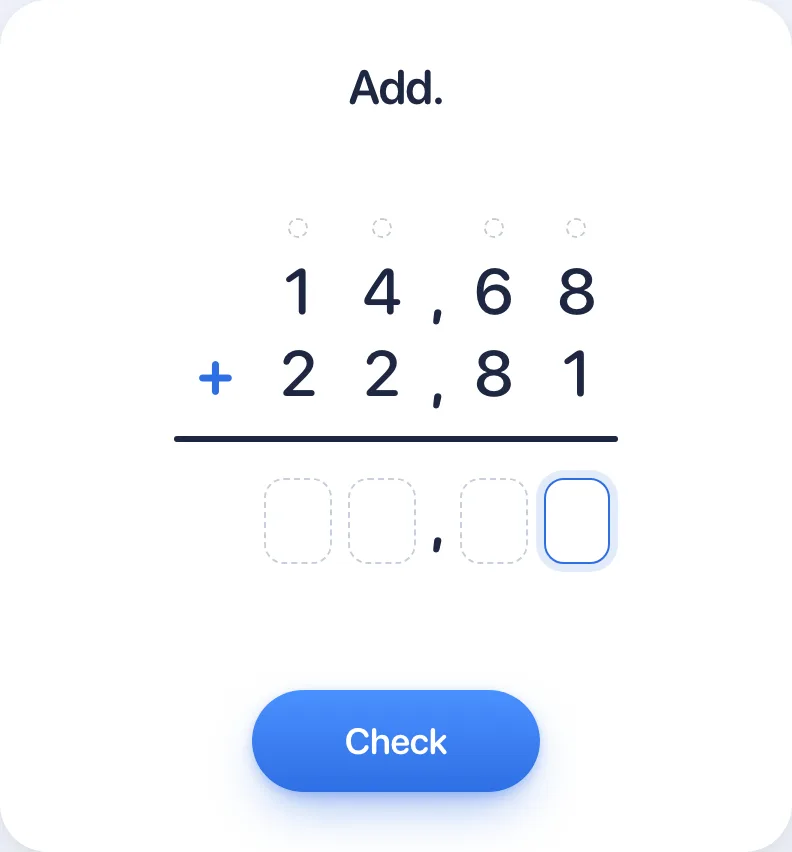
Worked examples
4.3 + 2.6
5.8 + 3.45
12 + 0.75
10 − 3.6
7.25 − 4.8
Frequently asked questions
How do you set out a decimal addition?
Write the numbers one under the other with the decimal points lined up, fill gaps with zeros if needed, then add from right to left as usual. The decimal point in the answer goes directly under the others.
Do you have to add zeros when adding decimals?
It isn't strictly necessary for addition, but it's strongly recommended: it prevents lining-up mistakes. For subtraction, it's often essential (8 − 2.45 is set out as 8.00 − 2.45).
When do children learn to add and subtract decimals?
In England, children add and subtract decimals in money and measures from Year 3 and Year 4, and with up to three decimal places in Year 5 and Year 6.
Keep reading: our lesson Calculating with decimals and how to compare decimals.
Find out where your child stands in 20 minutes
The EasyMaths assessment is free: around thirty varied questions covering the whole year’s curriculum, with clear results skill by skill and the exercises to work on next.
Take the free assessment →In the curriculum: Grade 4 (Year 4) · Grade 5 (Year 5) · Grade 6 (Year 6)
Keep reading
 Decimals
Dividing decimals by whole numbers
How to divide a decimal by a whole number with the bus stop method: the decimal point goes above the point, then carry on with zeros.…
 Decimals
How to compare decimals
How to compare two decimals: whole number part first, then tenths, hundredths… The 2.15 vs 2.9 trap, the 'add a zero' trick, diagrams…
 Decimals
How to round decimals
How to round decimals to the nearest whole number, tenth or hundredth: the 'look at the next digit' rule, the number line, the tricky…